The book has two parts. The first part has 3 chapters and talks about protein, why it's important, where you find it, and how to incorporate more of it in your diet. It was a lot more interesting than I expected to learn about how protein works and why most people need more in their diets. I also appreciated the recommendation to get protein from a variety of natural sources, not just powders or steak dinners. The author even gives meal plan suggestions with shopping lists. The second part is full of recipes split into 8 chapters: smoothies and shakes; high-protein breakfasts; salads, sandwiches, and wraps; plant-based mains, fish and seafood mains, poultry and meat mains, side dishes, and higher-protein snacks and sweets. The recipes have a good variety and while a lot of them require numerous ingredients, they're generally easy to acquire.
I've tried 3 of the recipes so far and have several more I'm interested in. The blueberry-lemon chia seed pudding was easy to make and delicious. It has a nice lemony tang that perfectly sets off the blueberries. The lentil stew was tasty. I've struggled to find lentil recipes I like, and this one turned out really good. The sheet pan spicy tofu and vegetables took some effort to prepare, but I loved the variety of vegetables, beans, and spices in one dish.
This is a great cookbook with recipes you'll want to incorporate in your weekly schedule.
Showing posts with label review. Show all posts
Tuesday, 16 June 2026
Tuesday, 9 December 2025
TV Show Review: Murderbot Season 1
IMDb listing; available on Apple TV
Pros: Skarsgard is brilliant as Murderbot, really good special effects and sets, interesting characters, good soundtrack, social commentary, thought provoking, lots to discover on subsequent viewings
Cons: uncomfortable to watch at times the first time through, a few gauche sexual comments
The first time I watched the show I’d only read the first novella in the Murderbot Diaries series by Martha Wells that this show is based on, All Systems Red. That was in 2018, so while I remembered the premise of the book, I couldn’t remember any details. I thought the story was interesting, the characters were fun, and the special effects and set designs impressively realistic. I also thought the show had a lot of cringey, uncomfortable moments.
The second time I watched the show I’d read all of the books and stories. This time I realized that the show is designed to be uncomfortable on one side and shocking on the other. The books are all told from Murderbot’s point of view. And Murderbot finds human interactions awkward and uncomfortable. By making the show uncomfortable to watch at times, the directors are putting US in Murderbot’s shoes. We feel uncomfortable because IT feels uncomfortable. My third time through I started noticing just how brilliant an actor Alexander Skarsgard is as Murderbot. While horror and discomfort come easily to its features there are very tiny, very subtle facial movements when it’s happy. On the flip side, several scenes are incredibly shocking and while Murderbot is nonchalant in the face of violence, the humans aren’t, so this time we’re put in THEIR shoes. Because of the shock you can’t appreciate the humour of Murderbot’s commentary in those scenes until you’ve watched them a couple of times and – like it – have become inured to the violence of their world.
The show also does an incredible job of showing not telling. There’s a scene in episode 7 where Murderbot is fighting an enemy SecUnit and the humans are ‘helping’ as a visual play on the sarcastic comments Murderbot scatters all over the books. It’s even funnier when they’re congratulating themselves for the good job they did in the next episode and we get flashbacks of what actually happened.
The musical score by Amanda Jones is great and reminds me of background music in the Portal games by Valve (composed by Kelly Bailey and Mike Morasky). The theme song for Rise and Fall of Sanctuary Moon is surprisingly addictive.
The show does deviate from the text in a lot of places. Several new plot twists were added to make up the run time for the season and most notably, except for Mensah the humans never really trust Murderbot.
I did find LeeBeeBee’s sexual comments genuinely uncomfortable, and not just in a Murderbot kind of way. Those scenes make it harder to wholeheartedly recommend the show to everyone I know who likes science fiction.
This is a show that, like the books, really benefits from contemplation and revisiting.
After finishing the show I came across a video called The Murderbot Ending is Different in the Best Way by Pete Peppers that covers Murderbot’s journey of emancipation. It’s really good and mentioned several things I’d missed. It contains full spoilers for the show, so only watch it if you’ve seen all the episodes.
Labels:
Murderbot,
review,
Science Fiction,
TV show
Saturday, 22 November 2025
Revisited review: All Systems Red by Martha Wells
I first read a year after it was published and loved it but thought it was on the short side. I like books with a lot of detailed world building and character development. Though I’d collected the other books in the series as they came out, I never seemed to have time to read them. I recently reread All Systems Red and continued with the rest of the Murderbot Diaries series (novellas, novels, and short stories), then read them all a second time and have a better appreciation for this book. Sometimes you find a book at the right time and it just speaks to you. And Murderbot’s journey has had a massive impact on me this time through. As the series continues you learn so much about the world and the other characters. As someone who never seems to know what to do or say in social situations, Murderbot’s anxiety is highly relatable. I also appreciate how, as the series progresses, the author deals with trauma and its aftermath. Murderbot's narrative has a dry sense of humour and sarcasm, which I absolutely love. As I've reread the books I've also discovered a real depth to the material. Each time through I learned new things, and could better appreciate Murderbot's journey. I'm also impressed how each book tells a different kind of story. One is about uncovering the past, one is a murder mystery, one is a rescue mission. This keeps the series feeling fresh, as it's not just similar plots with minor variations each time. I can't wait to see where Murderbot goes in the future.
Pros: interesting protagonist
Cons: short
Murderbot is a SecUnit made of cloned human and mechanical parts that’s hacked its governor module so it no longer has to obey commands. It’s been assigned to provide security for a small survey group looking at a new planet. But the group encounters an unknown hostile life form that wasn’t mentioned in the original survey report, which makes them wonder what else was missed - or possibly removed on purpose.
This is a 100 page novella, so it’s fairly short. That means it’s light on the world-building and character development. While you get to know Murderbot pretty well, the other characters, with the exception of Gurathin (who’s a light antagonist) and Mensah (the group leader) felt interchangeable. Having said that, Murderbot is fascinating and you really get inside its head.
The plot was interesting and quick paced. There are some tense moments, though the ending comes up so fast it didn’t feel particularly climactic (which may be due to my reading the story in 2 sittings instead of all at once).
It’s fun and entertaining and I’ll definitely read the next one.
So here’s my slightly modified 2018 review:
Pros: interesting protagonist
Cons: short
Murderbot is a SecUnit made of cloned human and mechanical parts that’s hacked its governor module so it no longer has to obey commands. It’s been assigned to provide security for a small survey group looking at a new planet. But the group encounters an unknown hostile life form that wasn’t mentioned in the original survey report, which makes them wonder what else was missed - or possibly removed on purpose.
This is a 100 page novella, so it’s fairly short. That means it’s light on the world-building and character development. While you get to know Murderbot pretty well, the other characters, with the exception of Gurathin (who’s a light antagonist) and Mensah (the group leader) felt interchangeable. Having said that, Murderbot is fascinating and you really get inside its head.
The plot was interesting and quick paced. There are some tense moments, though the ending comes up so fast it didn’t feel particularly climactic (which may be due to my reading the story in 2 sittings instead of all at once).
It’s fun and entertaining and I’ll definitely read the next one.
=> The next book in the series is Artificial Condition
Tuesday, 30 April 2024
TV Show Review: Fallout Season 1
IMDb listing
Pros: interesting character arcs, some great plot twists, good action sequences
Cons: lots of blood and gore, some nudity
Lucy MacLean leaves her mostly idilic nuclear fallout vault to rescue her father who’s been kidnapped by raiders. She is wildly unprepared for the world she finds on the surface.
I have never played the Fallout games though I watched part of a playthrough once (can’t say which game it was). So while I knew a handful of facts about the Fallout world (Pitboy, mutants, vaults), I was basically coming into the show blind.
I had concerns about the amount of gore in the trailer. I’m not a fan of gross humour/horror. So I watched the first episode as a test. And then kept watching. While there is a fair amount of gore, strategically closing my eyes at the right moment has helped (and the moments are generally telegraphed, so this worked well for me).
There are 3 main protagonists whose stories interweave, and they’re all compelling in their own ways. Two of them (Lucy and Maximus) have fairly simple backstories and motivations. The Ghoul’s story gets more and more complicated as the series progresses. The world’s complexities makes achieving their goals a real challenge. Watching Lucy confront her beliefs and see how she’s forced to change in order to live in this new world was heart-breaking. Ella Purnell is brilliant showing the progression from Lucy’s naivety to survivalism. Similarly, seeing who the Ghoul used to be before the nuclear blasts and wondering what’s brought him to this low point is interesting.
The set designs were beautifully done. I loved how they reinvented technology based on the divergence of history. The VHS style videotapes were kind of fun, as were some of the robots.
There were a lot of great fight scenes in a variety of locations. I appreciated that they were all fights for survival, rather than feeling cleanly choreographed. Everyone fights dirty in this world, or they die.
The story had some excellent plot twists (though, apparently many of these are known game storylines, so may not be surprising to those who’ve played them). I was happy that so many questions were answered by the final episode, while leaving enough to segway into a second season.
If you’re ok with gore and some nudity (one episode has a weird scene where a group of people derobe), then give this a try. The acting is great, the characters compelling, and the story shockingly good (especially compared to some other video game shows lately *cough* Halo *cough*).
Pros: interesting character arcs, some great plot twists, good action sequences
Cons: lots of blood and gore, some nudity
Lucy MacLean leaves her mostly idilic nuclear fallout vault to rescue her father who’s been kidnapped by raiders. She is wildly unprepared for the world she finds on the surface.
I have never played the Fallout games though I watched part of a playthrough once (can’t say which game it was). So while I knew a handful of facts about the Fallout world (Pitboy, mutants, vaults), I was basically coming into the show blind.
I had concerns about the amount of gore in the trailer. I’m not a fan of gross humour/horror. So I watched the first episode as a test. And then kept watching. While there is a fair amount of gore, strategically closing my eyes at the right moment has helped (and the moments are generally telegraphed, so this worked well for me).
There are 3 main protagonists whose stories interweave, and they’re all compelling in their own ways. Two of them (Lucy and Maximus) have fairly simple backstories and motivations. The Ghoul’s story gets more and more complicated as the series progresses. The world’s complexities makes achieving their goals a real challenge. Watching Lucy confront her beliefs and see how she’s forced to change in order to live in this new world was heart-breaking. Ella Purnell is brilliant showing the progression from Lucy’s naivety to survivalism. Similarly, seeing who the Ghoul used to be before the nuclear blasts and wondering what’s brought him to this low point is interesting.
The set designs were beautifully done. I loved how they reinvented technology based on the divergence of history. The VHS style videotapes were kind of fun, as were some of the robots.
There were a lot of great fight scenes in a variety of locations. I appreciated that they were all fights for survival, rather than feeling cleanly choreographed. Everyone fights dirty in this world, or they die.
The story had some excellent plot twists (though, apparently many of these are known game storylines, so may not be surprising to those who’ve played them). I was happy that so many questions were answered by the final episode, while leaving enough to segway into a second season.
If you’re ok with gore and some nudity (one episode has a weird scene where a group of people derobe), then give this a try. The acting is great, the characters compelling, and the story shockingly good (especially compared to some other video game shows lately *cough* Halo *cough*).
Labels:
Fallout,
post-apocalyptic,
review,
TV show,
video game
Tuesday, 22 November 2022
TV Review: W: Two Worlds Apart
Pros: fun romance, interesting characters, great concept
Cons: some disturbing content (suicide, torture)
Oh Yeon-joo is pulled into her father’s bestselling comic book series, “W”, and saves the hero, Kang Cheol’s life. Pulled between the two worlds, she falls in love with Kang and tries to shift the comic from being an action adventure to a romance story.
This is a Korean drama that aired in 2016, starring Lee Jong-Suk and Han Hyo-joo. IMDb listing.
Hard to find in North America as it’s no longer on Netflix here, I was lucky to find it in Europe on my recent trip to France.
The story is fun and quirky, with rules that get explained as the characters slowly figure out what’s happening. There are a few moments in the first two episodes where I felt embarrassed for Oh Yeon-joo, but the tense cliffhanger endings kept me watching. There are some heavy emotional moments and times when the story took a turn I wasn’t expecting.
The romance between the protagonists progressed at a good pace, though there was one moment where it seemed Kang had an unrealistic mood swing in Oh’s direction.
Cons: some disturbing content (suicide, torture)
Oh Yeon-joo is pulled into her father’s bestselling comic book series, “W”, and saves the hero, Kang Cheol’s life. Pulled between the two worlds, she falls in love with Kang and tries to shift the comic from being an action adventure to a romance story.
This is a Korean drama that aired in 2016, starring Lee Jong-Suk and Han Hyo-joo. IMDb listing.
Hard to find in North America as it’s no longer on Netflix here, I was lucky to find it in Europe on my recent trip to France.
The story is fun and quirky, with rules that get explained as the characters slowly figure out what’s happening. There are a few moments in the first two episodes where I felt embarrassed for Oh Yeon-joo, but the tense cliffhanger endings kept me watching. There are some heavy emotional moments and times when the story took a turn I wasn’t expecting.
The romance between the protagonists progressed at a good pace, though there was one moment where it seemed Kang had an unrealistic mood swing in Oh’s direction.
The special effects of going between worlds were really well done.
The show deals with free will, as the story begins with Kang just becoming aware that something is strange with his life. Learning he’s a comic book character, created to tell an entertaining story, creates turmoil in his life.
My only complaint with the show is that the writers (and characters who can effect reality in the comic book world) keep doing the same actions: providing a weapon and a getaway car. It seems that as they realized the potential of their ‘magic’, they could have done more interesting things to evade and outsmart the bad guys. Also, the English subtitles translated the web comic as 'cartoon', which I found inaccurate and distracting.
While it’s predominately a romance, this won’t be for everyone as the series also involves suicide and scenes of torture.
The show deals with free will, as the story begins with Kang just becoming aware that something is strange with his life. Learning he’s a comic book character, created to tell an entertaining story, creates turmoil in his life.
My only complaint with the show is that the writers (and characters who can effect reality in the comic book world) keep doing the same actions: providing a weapon and a getaway car. It seems that as they realized the potential of their ‘magic’, they could have done more interesting things to evade and outsmart the bad guys. Also, the English subtitles translated the web comic as 'cartoon', which I found inaccurate and distracting.
While it’s predominately a romance, this won’t be for everyone as the series also involves suicide and scenes of torture.
(Unfortunately this trailer I found for the show does not have English subtitles, but gives you an idea of the style & content of the show.)
Labels:
Korean drama,
review,
W: Two Worlds Apart
Tuesday, 20 April 2021
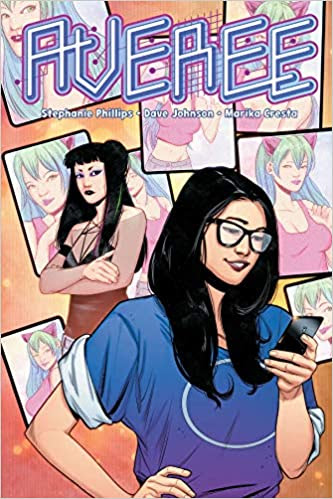
Graphic Novel Review: Averee written by Stephanie Phillips with Dave Johnson, Illustrated by Marika Cresta
Cons: ending is simplistic
In a future where your Ranked app scores decide where you can live, what restaurants you can enter, and how ‘cool’ you are at school, being at the bottom sucks. When the app is hacked and the scores of Averee and her mom drop suddenly, Averee faces prejudice at school while her mom’s job is in jeopardy. A friend’s idea to find the app’s founder sounds impossible, but just might be Averee’s only hope.
Averee is a 5 issue, self-contained graphic novel. The artwork is full of colourful pastels and simplistic backgrounds, letting the characters and plot be the focus. It’s easy to grasp the kind of world an app like Ranked would create, so little world-building was required. Having said that, the cattiness of some schoolgirls is very realistic and sells the setting.
I liked the friendship between Averee and Zoe, whose rank has always been low. Their arguments and resolution feel natural for their age. I also liked the budding relationship between Averee and Luke, the awkwardness of trying too hard while hoping it’s not obvious you’re trying too hard.
The plot is well paced across the 5 issues, and while the ending seemed a little simplistic (I feel like the trio would face more consequences for what they did), I did like the resolution.
Labels:
Averee,
Graphic Novel,
review,
Stephanie Phillips,
YA dystopian fiction
Tuesday, 23 April 2019
Manga Review: Heaven’s Design Team volume 1
Pros: great art, quirky characters, real creatures, examines why mythological creatures can’t exist
Cons: some adult humour
After God finished making the heavens and the earth, he needed creatures to populate it. He didn’t want to spend the time making all those creatures Himself, so He outsourced them. The team that got the job is pretty eclectic. One of them is so proud of the horse he made, that all his new designs incorporate them (hello pegasus and unicorn). Before designs can be approved however, they must pass the feasibility test by the team’s engineer to prove that they can actually survive on the planet.
This is a fun manga, with great black and white artwork and a quirky story. Each chapter ends with a page explaining the real creatures that inspired those approved in the story (and some of them are pretty weird). I love hearing the engineer explain why certain designs can’t work. I also loved seeing some of the designers fight, using evolution to create different versions of their creatures that can better compete for resources/survival.
It is a bit adult, in that one character constantly explains the, ahum, mating requirements of males, so this may not be appropriate for younger readers.
If you’re looking for a manga that’s fun and different, this fits that bill.
Labels:
Heaven's Design Team,
humour,
manga,
review
Tuesday, 5 March 2019
Great Courses Review: Food A Cultural Culinary History
Pros: interesting content, wide variety of subjects, lots of references
Cons:
This is a Great Courses series of 36 thirty minute lectures that start with humanity’s hunting and gathering in the ancient past all the way up to the experimental cooking of the 2000s. I saw this via my local library’s digital lending program (Hoopla).
I learned so much from these lectures. The breakdown is extensive with separate lectures for various religious groups, ethnic groups, time periods, etc. Even the early modern lectures that I thought I wouldn’t be interested in turned out to be fascinating.
The professor is enthusiastic and knowledgable, easy to listen to, and very clear. In a few lectures he actually reproduces recipes he discusses. I wish he’d done more of that (I originally thought he was going to do one of these per lecture).
If you like history and/or food, this course is delightful.
Labels:
food,
Great Courses,
History,
review
Tuesday, 22 January 2019
Great Courses Review: History of Spain: Land on a Crossroad
Taught by Professor Joyce Salisbury
This is a Great Courses lecture series on Spain. It consists of 24 thirty minute lectures starting in the stone age and ending with the modern era. I borrowed the DVDs from my local library and binge watched them in a week.
This is an excellent course and gives you not only a grounding in Spain’s history but a lot of interesting background information as well. The lecture on Christianity explained some of the councils that codified the teachings of the Catholic church as well as some of the beliefs deemed heretical. The lecture on Visigoths drew upon that knowledge as their king followed the teachings of one of the heretical leaders. The lecture on Islam went over it’s origins and how the religion spread before examining the Muslim conquest of Spain. I was hoping for a similar deep dive into Judaism, but the lecture on Sephardic Jews was specific to their actions in Spain with only a little bit about how the destruction of the Temple in Roman times contributed to their diaspora. The lecture on Gitanos was fascinating, as I knew very little about them and their history (and the professor discussed terminology and explained that this particular group prefers the term to being called Roma).
There were a few instances where I’d have liked more information. While Maimonides was briefly mentioned, there was no time to explain why he’s considered such an important Jewish philosopher or what his teachings were. Similarly the Inquisition only got a few brief mentions.
I had originally planned to skip some of the lectures but watched them all as the story was so fascinating I didn’t want to miss anything. The professor had a great voice that was easy to listen to and showed her own excitement for the subject matter.
I do wish there were a pronunciation guide for Spanish, as it took me a few lectures to figure out some of the words (for example, Galicia was pronounced Galithia, which made me wonder if the provinces changed names at some point). While many names were shown on the screen, there were times when this did not happen (as with Galicia). More maps as graphics would have been helpful too.
On the whole if you want to learn the basics - and then some - of Spain’s history, this is an excellent resource.
As a tie in for fantasy worldbuilding, Spain has been conquered and reconquered so many times (Romans, Suevi/Vandals/Alani, Visigoths, Muslims, Christians) and its culture shows that. It’s fascinating seeing how each group ruled and what impact that had on the people, with their mixture of tolerance at some times and expulsions and persecutions at others. The history also shows how important geography is with regards to warfare. Some mountain peoples were never conquered, the Pyrenees was a natural barrier to the north (though it didn’t stop a few invading armies), while the close proximity to Africa allowed the Muslims to head north in their push for expansion. The country had a lot of trade - within the Mediterranean, and when the ‘new world’ was ‘discovered’ across the Atlantic as well.
Labels:
History of Spain,
review,
The Great Courses,
worldbuilding
Tuesday, 18 December 2018
Graphic Novel Review: FTL, Y’all! : Tales From the Age of the $200 Warp Drive edited by Amanda Lafrenais
Pros: wide variety of stories, some excellent artwork, inclusive stories
Cons: often abrupt endings, not hard SF, some artwork I didn’t care for
First off, reviews are subjective. Everyone likes different things. This is even more apparent when it comes to artwork. So while some of the stories and some of the artwork didn’t appeal to me, that won’t be true for everyone. There’s quite a variety of both stories and artwork here, and the ones that didn’t work for me might turn out to be your favourites.
I was surprised by how many stories had retrofitted cars as spaceships. In fact, don’t think too much about the science in most of the stories as they generally don’t deal with the practicalities of space (like oxygen, radiation shielding, gravity, food, water, waste). The few that did, stood out, and I really enjoyed them.
There are 21 stories in this collection, and some of them are very short, almost more vignettes than full short stories. Some of them end abruptly, which I didn’t like.
The black and white artwork was varied. Some of the stories were gorgeous, some had artwork I couldn’t stand.
I loved the inclusive nature of the stories. There was a variety of characters from different racial backgrounds and sexual identities.
On the whole the collection is a good mix. There are some real knockout stories and some I personally didn’t care for, but it’s worth the read.
“M.S.P.I.P.S.P” by Kay Rossbach
**** Louanne Davis navigates the spaceport with her daughter before their flight to Mars to reunite with her wife. - I enjoyed the artwork. Anyone’s who’s flown will sympathize with Louanne’s plight as one thing after another goes wrong.
“Lia” by Alexxander Dovelin
**** A woman’s life work is used to capture experiences of space as viewed by androids. - The artwork seemed a little more realistic in style. I liked the story. It’s about finding people who believe in you, as you navigate a world where profit is everything.
“Microwave” by Jay Eaton
**** Rowan’s on her way to use a warp pod to travel to Seatle, but her uncles are driving her nuts with their talk of safety issues. - Not my favourite art style, but an interesting short story about being prepared to act when things go wrong.
“Cabbage Island” by Mulele Jarvis
**** Yu’s dream is to build a car that can warp through space in the hopes of finding a new planet to live on, as the world gets worse and worse. - I liked the artwork and the story was engaging. Not sure when Hondo had time to bake the cookies, and the ending wasn’t to my taste.
“Passing Through” by Jamie Kaye and Sunny
** Two friends chat about what they’re up to now. - There were a few panels (the ones in the bar) where I wasn’t sure what was going on. I do love the idea of having a personal transporter though, and being able to tour the world/galaxy. I was left wondering how the phone didn’t cut out each time the man teleported.
“Last Exit” by Christine Williamson and M. Kennedy
* Mary runs away from home to space and gets caught by the predatory bureaucracy. - I was not a fan of the artwork. I found the small script crowded and hard to read. Changing the engine’s not enough to make a car space worthy and she was woefully unprepared for the trip considering she left when she did out of pique rather than need.
“Ignition” by Iris Jay and Skolli Rubedo
* Rhea and Imogen are a salvage team hired by a fascist leader to recover the Discovery shuttle. - I didn’t like the artwork for this story and the story left me with a several questions.
“Wayhome” by Evan Dahm
*** A family makes a home in a new place, leaving the city behind. But isolation breeds paranoia. - I liked aspects of this story. The artwork was interesting and there’s a great paranoia reaction at one point. The ending was strange.
“Space to Grow” by N.N. Chan
***** A young astrobiologist blogging about her first solo assignment is beset by internet trolls. - I liked the artwork. I also appreciated that it depicts a common problem for internet creators. Negative comments can really bring you down, even if you’re doing what you love.
“Soft Physics” by Blue Delliquanti
*** People in disparate communities await packets of info, some of which contain the exploits of Phoney and Mandy. - The artwork wasn’t quite my style. The story was interesting but didn’t have much of a conclusion.
“Brilliant + Handsome” by C.B. Webb
*** Two boys build ships to go to Mars, one in a car, the other in a washing machine. - Didn’t like the artwork. I had to read the ending twice to understand what happened, but really liked it once I got it.
“Failsafe” by Rachel Ordway
** A pilot tries to commit suicide via black hole. - More of a vignette than a story, it does portray frustrated despair very well.
“I Want to Be Alone” by Seren Krakens
* Fed up with life among slobs, the protagonist takes off alone to find the perfect planet where they can be alone. - I found the artwork very confusing and had a difficult time understanding what was going on.
“Finders Keepers” by Ahueonao
***** Three friends attempt to loot an abandoned luxury space station whose AI killed the previous guests and crew. - Loved the artwork and the story was a lot of fun.
“Prodigal Sunset” by Sara Duvall and James F. Wright
*** A group of teens from various planets try to find a cure for the strange illness they share. - Nice artwork. I was left with a lot of questions.
“Words From the Dead” by Jonathon Dalton
**** Two archaeologist study the remains of the long dead Taucetian society. - I appreciated that the author paid some attention to science in this story. The artwork was ok. Loved the story’s ending.
“Story of a Rescue” by Nathaniel Wilson
*** Two kids and their pilot are heading out to find their dead beat step-dad. - The kids told a lot of back story, which seemed a bit odd as the pilot was older than them and I’d have expected him to have a better sense of current affairs. Loved the ending.
“Solitary” by David Andry and Paul Schultz
**** A prisoner’s sentence is commuted provided he sign on to a new program. - Interesting story that was well executed.
“Graddad’s Second Wife” by Cheez Hayama and Earl T. Roske
**** Sergio’s granddad needs help keeping his new wife - an alien - from ICE. - The alien was kind of disturbing, but the story was otherwise fun.
“The Senior Project” by Maia Kobabe
**** While other kids work on FTL thesis projects, Willow cultivates a fast-growing crop of Adzuki beans. - I liked the relationship that formed between Willow and Kai, as they both worked on their projects. I also liked the practical applications for Kai’s teleporter.
“My Stars and Garters” by Ainsley Seago
**** A couple builds a spaceship so they can live their most authentic Victorian lives away from people who find them strange. - I suspect people who live differently would be among the first to leave Earth should an FTL drive become cheaply available. An enjoyable end to the collection.
Labels:
Amanda Lafrenais,
FTL,
Graphic Novel,
review,
Science Fiction,
Y’all!
Friday, 24 August 2018
TV Show Review: Gravity Falls
Pros: fun characters, siblings that fight and still love each other, intricate storytelling, great humour
Cons:
Twins “Dipper” and Mable Pines are shipped to their great uncle’s place in the woods for the summer. Their grunkle Stan runs The Mystery Shack, a tourist attraction of bizarre made-up creatures and no refunds. When Dipper uncovers a mysterious journal he begins to see that there are real monsters and mystery in the town.
The show’s got a great supernatural overlay, making it feel like a kids version of X-Files paired with the weirdness and interconnected storytelling of Twin Peaks. There are hidden codes and astute viewers will see side characters pop up in strange places. It’s a great show for easter eggs and esoterica (if you don’t feel like solving all the mysteries yourself, you can find a lot answers/translated cryptograms online).
The characters are fantastic. I loved that the twins fight a lot but it’s clear that they also love each other and will do anything for each other. Quite a few episodes end with them working through their differences in order to save the day. The same goes for their friends and enemies. Each character has their own motivations, and work towards their own goals as the show progresses. As the two seasons are a continuous story, you really get to know everyone in town.
While it is a show for older kids, there’s a fair amount of adult humour. Not crassness, but jokes that will go over the heads of the kiddos that adults will enjoy. Most of these revolve around Stan’s being a con artist. So for example, in an early episode the kids are seen making counterfeit money as part of a family bonding activity. It’s also a show that gets better with each viewing. The first time through some of the characters/episodes annoyed me, but rewatching them I could see where the characters grew due to their interactions and how each story built into a larger whole. You’re also more aware of the various easter eggs and ongoing jokes peppered through the show.
Season one is basically monster of the day stories, while season two starts to tie the larger mysteries of the town together.
It’s great to find a show that’s so well written and brilliantly voice acted. The characters all seem real and the final episode really tugs on those heart strings. And when you finish watching, if you’d like more, there are some books that flesh out the world, including Journal 3. Gravity Falls is a wonderful rabbit hole to fall into.
Twins “Dipper” and Mable Pines are shipped to their great uncle’s place in the woods for the summer. Their grunkle Stan runs The Mystery Shack, a tourist attraction of bizarre made-up creatures and no refunds. When Dipper uncovers a mysterious journal he begins to see that there are real monsters and mystery in the town.
The show’s got a great supernatural overlay, making it feel like a kids version of X-Files paired with the weirdness and interconnected storytelling of Twin Peaks. There are hidden codes and astute viewers will see side characters pop up in strange places. It’s a great show for easter eggs and esoterica (if you don’t feel like solving all the mysteries yourself, you can find a lot answers/translated cryptograms online).
The characters are fantastic. I loved that the twins fight a lot but it’s clear that they also love each other and will do anything for each other. Quite a few episodes end with them working through their differences in order to save the day. The same goes for their friends and enemies. Each character has their own motivations, and work towards their own goals as the show progresses. As the two seasons are a continuous story, you really get to know everyone in town.
While it is a show for older kids, there’s a fair amount of adult humour. Not crassness, but jokes that will go over the heads of the kiddos that adults will enjoy. Most of these revolve around Stan’s being a con artist. So for example, in an early episode the kids are seen making counterfeit money as part of a family bonding activity. It’s also a show that gets better with each viewing. The first time through some of the characters/episodes annoyed me, but rewatching them I could see where the characters grew due to their interactions and how each story built into a larger whole. You’re also more aware of the various easter eggs and ongoing jokes peppered through the show.
Season one is basically monster of the day stories, while season two starts to tie the larger mysteries of the town together.
It’s great to find a show that’s so well written and brilliantly voice acted. The characters all seem real and the final episode really tugs on those heart strings. And when you finish watching, if you’d like more, there are some books that flesh out the world, including Journal 3. Gravity Falls is a wonderful rabbit hole to fall into.
Labels:
cartoon,
Gravity Falls,
review,
TV show
Tuesday, 6 March 2018
Comic Book Review: Denver Moon #1: Murder on Mars
Denver Moon is a private eye investigating a series of prostitute murders on Mars. But is it really murder if the victims are bots?
This is the first of 3 comic books, which will be bound into a graphic novel entitled Metamorphosis later this year. Issue one is currently on comiXology and will be available in print on June 5th. The comic is based on a short story of the same name, which is a prequel to a novella also out on June 5th called Denver Moon: The Minds of Mars.
This issue is purely set-up. You’re introduced to Moon and the case and a bit of the background regarding the state of affairs on Mars. I liked the artwork which has soft edges and an almost painted look. Scenes outside have a definite Blade Runner Asian/neon vibe.
As extras, there’s some concept art for the main characters and the first section of the short story, which retells the same things as the comic, only with some added details. I actually found the comparison fascinating: what physical details needed to be included in the written rather than visual account as well as which details were cut for the comic to save room without compromising story.
This is a great start with an interesting protagonist and setting, and I’m curious to see where it goes.
Labels:
comic book,
Denver Moon,
murder mystery,
review,
Science Fiction,
SF noir
Tuesday, 26 September 2017
Graphic Novel Review: Lady Mechanika: La Dama de la Muerte by Joe Benitez and M. M. Chen
Pros: gorgeous artwork, touching story
Cons: makes the locals look ignorant
Mourning the death of a friend, Lady Mechanika makes her way to Mexico, where she’s coerced into joining the Day of the Dead festivities.
This graphic novel gathers a 3 issue storyline.
As with the previous volumes the artwork is simply gorgeous. I love the costumes and make-up associated with the festival. There are some beautiful double page spreads.
I enjoyed the story, though it does depend on the ‘superstitious natives are easily duped’ trope and it’s not particularly original. I found the opening beautiful and sad, despite the positive message of the festival.
I was confused by who Dallas was. He isn’t mentioned in the earlier volumes nor was there a flashback explaining how he died or any explanation of why Mechanika felt responsible for his death.
Despite a few minor issues, I love this series. Each volume stands alone and uses unique new locations and outfits. The artwork really is worth it.
Tuesday, 2 May 2017
Graphic Novel Review: Spill Zone by Scott Westerfeld
Illustrated by Alex Puvilland
Pros: atmospheric, interesting characters, intriguing story
Cons: a little slow
No one knows what caused the Spill Zone, but its dangers are numerous. Addison supports herself and her younger sister by sneaking into her old hometown, now a quarantine zone, and selling the pictures she takes. She stays safe by obeying a set of rules. Now she’s offered a large sum of money to bring something back from the zone, but it means breaking the rules…
This is the first volume and so mostly sets up the spill zone and the characters. It’s a bit slow, but that’s due to the many panelled atmospheric nature of the artwork. While the artwork wasn’t entirely to my liking, it does embody the post-apocalyptic feel of the city and the creepy stuff going on inside it. It’s also highly expressive, showing a lot of motion and emotion.
Addison’s pretty interesting as a protagonist, gutsy if not terribly business savvy. Her obvious love for her sister shines through. I have to admit, I’m most intrigued by Vespertine, her sister’s telepathic, snarky doll.
The story ends with several mysteries introduced and I’m very curious to see what happens next.
Labels:
Alex Puvilland,
Graphic Novel,
review,
Scott Westerfeld,
Spill Zone
Tuesday, 30 August 2016
Comic Review: Battlestar Galactica Issues 1 and 2
Just before the peace negotiated by Baltar between the alien created Cylons and the humans of the Twelve Colonies, can be ratified, there’s a surprise Cylon attack. But they don’t just destroy the fleet, they also target the colonies themselves. Only one battleship remains: Battlestar Galactica, which escorts the remaining survivors on a quest to find their ancestral home: Earth.
Written in 1979 and based closely on the TV show that aired the year before, the comic books are fun to read. Some scenes from the show are removed, likely due to space (some of the set up with Zac and Apollo’s mission, Starbuck talking with Athena while she’s changing, etc.). The missing scenes tend to be character development moments, things that help with getting to know who everyone is and the interpersonal relationships between them. Unfortunately, losing Zac’s scenes removed some of the tension the TV episode builds up.
The first issue ends with the ships heading out on their quest to find Earth. The second comic covers the pilots checking over the ships in the new fleet and ends with them beginning their mine field piloting mission. I suspect a third issue would finish the events of the pilot episode.
The artwork is nice, and follows the designs of the show closely. I didn’t realize until I watched the show that the pilots helmets look like ancient Egyptian headdresses, which was kind of neat.
The comic also does away with the narration that the episode begins with, which explains that this all takes place somewhere distant.
I suspect the comic was meant to drum up interest in the show and/or be a collector’s item. It’s a neat piece of history.
Labels:
Battlestar Galactica,
Comic,
comic book,
review,
Science Fiction
Friday, 26 August 2016
TV Show Review: Battlestar Galactica Episode 1 (1978)
I saw this a few years ago when I watched the 2004 remake, but watched this again today so I could compare it to the first two issues of the 1979 comic books (volumes 1&2), which I will be reviewing on Tuesday.
Pros: some great characters, brilliant world-building, good special effects, excellent music
Cons: rushed storytelling
Just before the peace negotiated by Baltar between the alien created Cylons and the humans of the Twelve Colonies, can be ratified, there’s a surprise Cylon attack. But they don’t just destroy the fleet, they also target the colonies themselves. Only one battleship remains: Battlestar Galactica, which escorts the remaining survivors on a quest to find their ancestral home: Earth.
The pilot episode had a lot of ground to cover and clearly didn’t want to spend much of that time on the destruction of the fleet and colonies, taking a fair amount of time to set up some of the characters on Galactica, then jumping ahead to the humans in their scrounged ships leaving on their quest. Having said this, a surprising amount of time is also spent on a planet they encounter later in the episode that might have been better served as the plot of the next episode, as it tells a mostly self-contained story. But this first episode was apparently marketed as a TV movie, so maybe they needed to fill out the time slot. And maybe the battle/destruction would have cost too much to do properly, so they opted to bypass most of it.
The character building at the beginning does mean several protagonists are quickly remembered, which I thought was well done considering the size of the cast. I also liked that there was some diversity in the cast.
The acting’s pretty good, if at times over the top - I’m looking at you, Starbuck. The scene with Zac at the beginning gets quite tense.
I have to admit that Boxey, the kid, is kind of annoying, as he’s always running off. While I liked his mother (played by Jane Seymour), she’s clearly unable to keep track of him.
The special effects are quite good considering when this came out. There are a lot of similarities to Star Wars in this respect, with the heavy use of models and lazers lights.
The world created is quite rich, with specialized terms. It’s only touched on but the different colonies appear to have some different accents/dialects, religious practices, etc.
One of the best aspects of the show is the music, which was fully orchestrated and sounds amazing.
The show has a bit of camp - as must be expected given when it was made. But the remake took a lot of liberties with the story (and made some great changes), which makes the original worth watching.
Labels:
Battlestar Galactica,
review,
Science Fiction,
TV show
Friday, 13 November 2015
Review: The Great Courses: Dante’s Divine Comedy
Professors: William Cook and Ronald Herzman
The professors work in tandem to impart their extensive knowledge of the Divine Comedy. The set consists of 24 lectures, with four lectures of set up (one going over editions, one on Dante the poet and two on his literary influences), seven on Inferno, five on Purgatory, and seven on Paradiso.
Given the complexity of the poem, the lectures focus more on the skills you need to puzzle out the meanings of the various cantos on your own. In some cases they show you how to read the poem so that you get the most out of it. For some of the most important and/or difficult cantos, they look in more depth, sometimes spending the entire lecture on one or two cantos.
There’s a lot more regional politics in the poem than I expected, and the poem itself is much more interconnected and complex than I understood. This is a series to watch, and rewatch, numerous times - before, during and after you read them poem - so you can get the most out of the poem and better understand what Dante was saying.
I started reading Inferno before I watched the first lectures and was amazed at how much I missed, even with the fantastic end notes of the translation I used. There’s just so much there.
Labels:
Dante,
Divine Comedy,
lectures,
review,
The Great Courses
Tuesday, 21 July 2015
Novella Review: After the Fall, Before the Fall, During the Fall by Nancy Kress
Pros: interesting characters, quick read
Cons: issues with ending
In 2013 an FBI agent partners with a mathematician to try to solve a series of child kidnappings. In 2014, a series of ecological disasters occur. In 2035, a tiny group of people try to increase their population enough to save humanity from extinction by grabbing children from the past.
Told in three periods, the before, during and after of the title, this novel explores the activities surrounding an apocalyptic event. It’s a short, quick read, at just under 100 pages. There’s a fair amount going on in the story, especially as tensions in the future mount among the young men.
The characters are all pretty interesting to read about. Julie’s probably my favourite, as she knows what she wants and, until the end, is confident in her decisions. I found Pete sympathetic, but not the most likeable character. Still, his story was interesting as he interacted with the others in the future.
I had a few issues with the ending, particularly since several rather important issues were never explained. I’ll detail these in the spoilers section.
Despite not being entirely satisfied with the ending, this was an enjoyable, quick read.
***Spoilers***
The ending implies that the apocalypse was caused by Gaia - meaning ‘the earth’ - in order to counteract the actions of humans in the past century. So, knowing humans would make a hash of the world again - eventually - why save some? Why not just wipe out humanity and save some animals, things that respect their places in the circle of life? I was also surprised that the Tesslies let the humans live - and leave the enclosure - once they realize that the negative emotions that ultimately led to the need for the apocalypse - jealousy and hatred - were still present.
Most importantly, what are the Tesslies? The impression I was left with was that they were an extension of Gaia. In which case, how did they create the metal enclosure, the water purifier, the disinfectant machine, the time machine and how did it pick and then teleport the humans to the enclosure? And why so few? I have trouble imagining how this group could repopulate properly, even with the kids they grabbed from the past. There are simply too few people left.
My other question is, who did people think planted the supposed underwater bombs they believed caused the tsunamis? And how many bombs would you need to wreck the coastlines? Everyone starts nuking each other, but why? How would nukes help anything? Whoever survived would be further negatively impacted - as would Gaia. And whatever enemies you thought were responsible would have caused a lot of destruction on their own lands too.
Labels:
After the Fall,
apocalypse,
Before the Fall,
During the Fall,
Nancy Kress,
Novella,
review
Tuesday, 18 February 2014
Graphic Novel Review: Leaving Megalopolis by Gail Simone and J. Calafiore
Cons: some gory scenes
A group of civilians tries to leave Megalopolis, The Safest City Anywhere, after the heroes who once protected the city begin killing everyone.
I bought this comic as part of a kickstarter campaign. Its production was delayed due to illness and an extension of the story, so I only got it recently. It was worth the wait.
Megalopolis is a cosmopolitan city, so the characters in the book are from varied backgrounds. Mina, the caustic ‘leader’, had a traumatic childhood, seen in flashbacks, that makes it hard for her to care for anyone other than herself. Yet she forms a group that hopes to make it out of Megalopolis to safety.
The comic is filled with harsh realities, some swearing and the aftermath of horrific acts. However, there’s also something amazing in the idea that humans - under the worst circumstances - can become heroes in their own right. The characters constantly try to pass off responsibility - for their lives, for their safety - to others, only to have it made perfectly clear that if a hero’s coming, they’ll have to play that role.
The story expects you to piece together what’s happening and works perfectly for an apocalyptic premise. I really liked the realism of the artwork and the fact that some of the more gruesome acts were hinted at rather than shown.
It’s a pretty brutal story but a great start to a series.
Labels:
Gail Simone,
Graphic Novel,
J Calafiore,
Leaving Megalopolis,
review,
superheroes
Thursday, 6 February 2014
Graphic Novel Review: Code Monkey Save World
Written by Greg Pak, Based on the songs by Jonathan Coulton
Illustrated by Takeshi Miyazawa
Pros: quirky characters, bizarre plot, great illustrations
Cons: you’re missing out if you don’t know the songs it’s based on
My husband bought this as part of a kickstarter campaign. The story is based on Jonathan Coulton songs. The only song of his I was familiar with (beyond a vague memory of something about 'skullcrusher mountain') were the ending theme songs for the Portal video games and not ones alluded to in the story. The upside is that you don’t need to know the songs the story is based on in order to really enjoy the quirkiness of this graphic novel, but I imagine there’s a lot of subtlety I missed because I didn’t know the references. [The kickstarter also included digital downloads of acoustic versions of the songs used in the graphic novel, which I listened to after reading it. And yes, there are a lot of minor references and details I didn’t pick up on the first time.]
Charles is a monkey who writes code for SCM Industries. He’s enamoured of the secretary who works on his floor and annoyed by his in-your-face manager. When robots attack their office and his co-workers are kidnapped, Charles is drafted by the company’s CEO, ‘Skullcrusher’ to defeat The Robo Queen. But Skullcrusher’s not so concerned with rescuing Charles’ crush as he is with proving he’s an evil genius and convincing The Robo Queen to love him.
There’s a lot more going on than that summary indicates, most notably with the zombies. The story jumps around a bit, but it’s always entertaining and hilarious, making me laugh out loud on several occasions. The characters are all quirky, with the villains being the right cross between creepy and funny.
The artwork was fantastic, very expressive and brilliantly coloured. I especially loved The Robo Queen’s metal armour.
This is a great 4 issue graphic novel.
[You can preview and buy all of Jonathan Coulton's songs on his website, and you can get the comic, up to issue #3 at Monkeybrain Comics and ComiXology.]
ETA: Since there's a lot of music on his site, here are some songs to start you off: Code Monkey, Skullcrusher Mountain, Re: Your Brains, Better, Creepy Doll, The Future Soon, and Chiron Beta Prime, all of which influenced this comic in some way.)
Subscribe to:
Posts (Atom)