Showing posts with label children's fiction. Show all posts

Friday, 22 August 2014

Blast From the Past: Ella Enchanted by Gail Carson Levine


Before I started reviewing books online I loved rereading my favourite SF/Fantasy books.  Since I don’t have time to do that anymore, this column is a trip down memory lane, where I’ll rave about books I love to read.  And then read again.  These aren’t reviews, as I won’t necessarily mention criticisms, they’re my chance to fan girl about books I love and hopefully garner some interest in some older titles.
--------------------------------

Ella Enchanted is a retelling of Cinderella wherein a fairy curses Ella with the need to follow all orders she receives. She's advised early on to not let others learn of her affliction, because unscrupulous people could use it against her in devastating ways.  People like her father and new step-family.

I read this book because of the movie that came out in 2004 starring Anne Hathaway.  The book shares the same basic plot, but there are some major deviations, especially the ending and the amount of slapstick humour the movie relied upon.  

This is a kids book that's smart in all the right ways.  Ella is clever and funny, a good friend and kind person.  Watching her fall for the prince is a joy but the complications that arise from it are heart-wrenching.  It's also a book that will have you laughing out loud at some parts and crying softly at others.  But mostly laughing.  

It's s short book and a quick read, but one that will stay with you long after you close it.


Thursday, 29 May 2014

Book Review: Enchantress From the Stars by Sylvia Louise Engdahl

Note: I picked up this book because Sharon Shinn mentioned in in her Recommended Reading post.
-------------------------------------------------------------------------------------------------------------------

Pros: brilliant premise, real consequences for actions, realistic viewpoints for the 3 cultures, thought provoking


Cons: Elana’s a bit irritating

Elana is in training to become a member of the Federation’s Anthropological Service when her spaceship is diverted to Andrecia for a crisis.  Her father, the most senior member of the service on board is ordered to deal with the situation along with her intended and another member of the service.  After sneaking onto the landing shuttle, Elana becomes a central part of their plan when disaster hits.

Jarel is an apprentice medical officer in the Imperial Exploration Corps, helping with the clearing of land for a new base before the take over of Andrecia and the removal of its native population to a reservation.  But he wonders if the natives whom they have captured are human, like him, rather than subhuman as he’s been taught.

Georyn is a native of Andrecia.  While on the way to ask the king for permission to attack the dragon that’s been ravaging a nearby forest, he and his brothers pass the Enchanted forest and meet an Enchantress.  She warns them that defeating the dragon will be dangerous and advises them to return if they need her help.  Georyn and one brother do return to her and learn magic that will help them free their world from danger.

This is a fantastic story about how point of view differs depending on culture and technological (and other) advancements.  It’s based on the premise that sufficiently advanced technology appears like magic to those of less advanced societies.

This is also a coming of age story for the three protagonists, though more time is spent from Elana’s point of view, as her technology is the highest level, and so her viewpoint is the most expansive.

I found Elana a little irritating at the beginning, as she’s still in training and therefore doesn’t understand what’s really going on on the planet, thinking of their stop as an adventure.  She’s faced with a number of humbling experiences that cause her to question the service’s methods and realize that primitive technological ability does not equal a lack of intelligence.  She faces real consequences for the knowledge she gains.

Jarel’s point of view is difficult, or rather, uncomfortable to read.  As a colonizer, even one who questions what they’re doing to the natives, he still believes in the natural inferiority and inherent inhumanity of those whose technology isn’t equal to theirs.  Though he foreshadow the ending in ways that don’t quite feel natural given his position and narrative, the author does specifically point out these moments, showing she was aware of this and making a point with them.

I loved Georyn’s point of view.  Seeing magic in Elana’s actions and performing quests like those from fairy tales, was really cool.  I loved that he often figured out what was happening with regards to his training on his own and that he’d manufacture explanations for Elana’s actions that fit with his beliefs about her and her purpose.

The book on the whole is quite thought provoking.  Originally published in 1970 and reprinted in 2001, this is a book that deserves to be more widely read.

Wednesday, 13 April 2011

Book Review: The Rendering by Joel Naftali

Pros: excellent pacing and tension, nifty creatures

Cons: technology gets farcical, fun but stereotypical protagonists

For Parents: some violence

I've mentioned before when writing children's book reviews that some appeal to all ages and others just to kids.  I'd put this book in the kids category.  It was a fun romp that made good use of the blog post format to help with pacing and tension building, but by the end of the story the unbelievable technology and crazy creatures were a bit much for me.

Doug's guardian, Antie M, works for a secret weapon's laboratory.  One night, while she's working late and he's playing videogames in the staff room, evil Dr. Roach and a group of mercenaries break in and steal equipment.  Their goal: to digitize all the people in the world and create a utopic society using the protocal program and hotlink created by the lab.

As the first book in a series, this book introduces you to thirteen year old Doug - a boy who's not so good in school but rocks at videogames, and Jamie - a computer genious who wants to be a scientist when she grows up, and their Cyberskunk protectors.

The intended audience (10 and up) will love reading Doug's blog posts about how he's not responsible for the bombing of the medical facility near his town (actually the high tech weapon's laboratory).  They'll love learning about the creation of the Cyberskunks and hearing about how Doug faces Dr. Roach and mercenary commander Hund.  They'll sympathize with him when his digitized aunt comes online to tell him he has to finish his homework before doing another post.

Adults... well, it is a fun read, with some violence but otherwise no objectionable content.  The short blog posts format helps create and maintain the tension in the story that's pretty intense anyway. 

Friday, 12 March 2010

The People of sparks, Book Review

By Jeanne DuPrau

Pros: good moral without being preachy

Cons: the characters act in less realistic manners than in her previous book

The People of Sparks picks up immediately from the end of The City of Ember. But don't expect a story about the evacuation of Ember to the surface, DuPrau skips over the problems associated with leaving in order to focus on the difficulty the Emberites have aboveground.

Enter the village of sparks, Though there are more refugees than villagers, Sparks' leaders agree to feed and house the Emberites for 6 months. Oddly enough, the people of sparks never sit down with the Emberites to find out what they're capable of and what they know. This lack of knowledge and the gradual resentment that grows among the people of Sparks creates problems among the two groups.

Meanwhile Doon falls under the influence of a leader in the making, who feels the people of Sparks aren't doing enough to help them and Lina tries to learn more about the city of her drawings.

The novel teaches reasons conflicts arise without being overly didactic.

Thursday, 11 March 2010

City of Ember, Book Review

By Jeanne DuPrau

Pros: realistic character motivations, interesting plot and setting

Cons: a bit slow at times, unrealistic storage time and use of canned goods, etc.

Ember is a city underground. Its people live in buildings and use electricity and goods prepared for them by the Builders. But the city is old. The stored food and supplies are running out. And the generator is slowly failing.

Lina Mayfleet is a new messenger in the city. She uncovers a mystery that might lead to the exit of Ember and the survival of her people. Towards this end, she refriends Doon Harrow, whose job in the pipeworks has allowed him to uncover a few mysteries as well.

The plot is straightforward. The city is failing and only a few people are actively looking for a solution. And unlike some children's books with child protagonists who save the day, The City of Ember's scenario is plausible. I could understand the adult's desire to keep the status quo, to hope that life could continue the way it always had. Meanwhile the antagonists are merely people looking out for their interests about those of the others in the city. Again, perfectly plausible.

The one thing that is not plausible is the idea that canned food, vitamins and other items can last 200+ years and remain usable. But most children won't notice this and as an adult reading the book it didn't detract from the story.

The story proceeds slowly, allowing for development of Lina and Doon. You get a good feel for the city and some of the citizens' attitudes. The blackouts are shown to be suitably horrifying, emphasizing the need for an exodus.

And like the children they are, both Lina and Doon want the attention and admiration of their elders, causing them to make some inadvisable decisions.

A great novel for children. It teaches a few good lessons without being preachy.

Thursday, 20 August 2009

Children's Books

After I finished university, I decided I needed some down time and came up with a plan to read children's stories. Some were stories I read as a child and loved, others were books I'd always wanted to read and never had the chance.

I discovered there are two types of children's books. Those you love as a child and those you love at any age. Let me explain. Some books have children protagonists that are fun to read as a kid but harder to relate to as an adult, while others have situations that you can relate to at any age (or are just so strange you like despite being older). Now, the books that go into either category will be different for each individual, based on everyone's personal tastes.

Roald Dahl had books that went into both categories for me. During my reread, I found that The BFG, which I loved as a child, was no longer 'realistic'. I just couldn't relate to or believe in the seven year old girl who saves the world. On the other hand, Charlie and the Chocolate Factory remains one of my favourite books of all time.

And many of those early books gave me a taste of the impossible, the improbable, fantasy and letting my imagination run wild.

What are some books you've read as an adult that you still like? Or ones you found you could no longer enjoy?

A few examples of children's books I still enjoy are:
James and the Giant Peach - Roald Dahl
The Seventh Princess - Nick Sullivan
Mrs Frisby and the Rats of Nimh - Robert C. O'Brien
The Hobbit - J.R.R. Tolkien
Dragonsong - Anne McCaffrey

(Note, this list would be longer if I included children's books I read only as an adult, if I'd reread more titles (I'd love to reread the Mouse and the Motorcycle) and if I gave myself more time to think of books.)

Thursday, 6 August 2009

Tale of Despereaux - Book Review

I'm going to do something I've never done on this site before: give a 'negative' review.

I did not like the Tale of Despereaux by Kate DiCamillo. But the reasons I did not like it are precisely the reasons why children will/do.

I've been reading fantasy since I was a child. I no longer need 'help' in feeling I'm inside the novel. Kate DiCamillo employed a writing style wherein she asks the reader to 'picture' things or 'feel' things. She also addresses the reader so often that, for me, it made it harder to stay in the story. But this is just the sort of language that helps kids feel like they are participating in the action. In fact, I imagine reading this story to a child would be a lot of fun.

Another thing that made it hard for me was the constant starting and stopping of the story by way of introducing another main character. This is not a story that reads linearly. There are three beginnings. Each one brings the reader up to speed about the lives of the characters - Despereaux (the tiny mouse), Roscuro (the evil - or not so evil - rat), and Miggery Sow (the unwitting facilitator of Roscuro's revenge). Again, for children, this works.

The chapters are all short, adhering a child's attention span. And any difficult words introduced are also explained within the text, making this a potentially good reading primer for young children.

Finally, the writing is superb. If you're an adult reading this to yourself, well, it's a matter of taste. But I'd suggest finding a child to share the story with. There are several fun characters if you like telling stories with 'voices'.

Friday, 10 July 2009

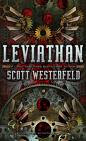
Leviathan - Book Review

For readers 12 and up who want some fantastic elements to make their history more palatable, there's Leviathan by Scott Westerfeld, coming out in October of this year. It's an alternative history steampunk, a sub-genre that is becoming very popular.

The book begins with two characters in very different circumstances. One is a girl, dressing up a boy, in order to join the British airforce. The other, Alek, is an Austro-Hungarian prince who's just been orphaned. The death of his parents sparks a war (World War I) and that's when things get interesting.

The book shows many different things. There's the ideological differences of nations (Germany & Austro-Hungary on one side, France, England and Russia on the other) and religious/technical differences (Darwinists vs 'Clankers' - those who use machines). The Darwinists have created creatures from the lifethreads of various animals to perform jobs that machines do in nations that consider such tinkering abominable.

Scott Westerfeld does a great job of realizing the steampunk machines on one side of the war as well as the more interesting 'beasties' on the other. My only complaint here is that the description of the airship Leviathan isn't as detailed as I would have liked. It was hard for me to picture some of the aspects of the beast. Maybe a cross-section diagram of the ship would have helped in this respect.

Speaking of diagrams, the gorgeous artwork throughout the book by Keith Thompson really brings the story to life. Seeing the beasties, the mechanical walker and the characters helps one better enter this world.

Beyond that, the story was tight and fast paced, though I found Alek a little tiresome as the book wore on. He never seemed to learn from his mistakes - always acting first and thinking later. Which isn't out of character as he's only 15. As an adult I simply wanted him to smarten up a bit.

Be prepared to wait for the sequal. This is a great beginning, explaining the background to the war, the people and all of the technologies involved. There's definitely more to come.

And the coup de grace? Westerfeld has an afterward explaining the actual history vs his imagined one - so kids can have a fun story and learn what was true and what wasn't. And it's an interesting mix.