Showing posts with label alchemy. Show all posts

Tuesday, 19 March 2019

Splendor Solis: The World’s Most Famous Alchemical Manuscript by Stephen Skinner, Rafal Prinke, Georgiana Hedesan and Joscelyn Godwin


Pros: in depth discussion, full translation, summaries are useful for quick reference

Cons: 

Note: I received a copy for review from the publisher via NetGalley. My copy did not include the manuscript reproduction pages for the illustrations, therefore I cannot comment on the images or their quality. 

The book gives the historical background of the Splendor Solis and then a new English translation of the Harley manuscript 3469 version, currently held by the British Library (and viewable online here. Click on the image below ‘view bindings’ to see the pages). 

There is an introduction and four chapters, followed by a glossary of alchemical terms and other alchemical works the Splendor Solis refers to. The chapters are: History and authorship of Splendor Solis, Inventing an alchemical adept: Splendor Solis and the Paracelsian movement, Commentary on the text and plates of Splendor Solis and finally Translation of the Harley manuscript.

The chapter on the history of the manuscript is very scholarly and quite dry. I appreciated that Prinke mentioned the history of scholarship regarding the Splendor Solis, in terms of printed volumes, manuscripts, the illustrations and attempts at discovering the author and illustrators. He even includes recent scholarship on the topics. I was disappointed that there was such a limited discussion on the antecedents of the artworks, the topic that most interested me. Instead of showing examples of where the Splendor Solis’ illustrators received inspiration, he simply offhandedly mentioned the works with little to go in if you’d like to research this topic yourself. When discussing the Aurora Consurgens’s artistic lending he merely cites the page of an English translation that got a 200 copy print run in 2011 and is quite difficult to find. I did find an older reproduction of the Aurora Consurgens online (digitized by Zurich’s Zentralbibliothek), but Prinke gave so little descriptive information that I found it difficult to identify which images he was comparing. 

I really enjoyed the essay on the Paracelsian movement. There was a lot of information here I was unaware of and it was fascinating to learn about.

The next chapter summarizes all of the passages in the manuscript and gives a thorough description of the illustrations and their meanings. It is here that the reproduced manuscript pages are found. The information is in clear language with translations of any text that appears in the images.

I was a little surprised there was a summary of the text followed by a full translation, but the translation’s fairly dense, so it’s actually quite useful to have read the summary and explanation before digging into it. It meant I came away with a much better understanding of what I read.

As stated above, I can’t judge the quality of the images included in this edition, but the text alone is definitely worth the price. It’s a deep dive into the Splendor Solis and a worthwhile addition to your collection if you’re interested in alchemy.

Friday, 6 July 2018

Alchemy Laboratory Part 3: Putting It All Together

You can see parts 1 and 2 of this project here.

Once the box was finished I was able to start adding decorations to it.

The left wall had three framed items: butterflies, a bat, and fairy wings. I rolled up some alchemical images and laid them in the corner. The celestial sphere at the base of the bookcase sits on a custom 3D printed stand and has some glow in the dark crystals on it.


Around the corner is the bookcase. The top shelf had natural history items, followed by alchemical images, tarot cards, the metal flower, an accordion book, etc. The remaining shelves were stocked with books, including one with a clasp closure (not seen in these pictures is the magnifying glass that was added later). On top sits a glow in the dark skull. After this picture was taken I added some black ink to it to give it more definition.

Beside the bookcase is a hanging metal owl and two shelves. The top shelf has a 3D printed chest of drawers and several filled bottles (more bottles were added after these pictures were taken). The lower shelf has a test tube holder and more bottles. Below them is the alembic on the furnace. Anachronistic tubing leads to a glass container and a vial on the floor. A container on the other side helps fill the middle vial. On the wall is a dance of death image by Hans Holbein the younger and a 3D printed alchemical symbol of Nicholas Flamel.

 The furnace has several pairs of tongs and pliers leaning against it and hung on the wall next to it, along with a bellows. Above the tools is a cameo of the Virgin Mary.


 Here's an image with the completed walls and back. I then glued down the table, making sure the candle wire went up the leg and was glued to the table top. It's got an armillary sphere, scales, several experiment pieces including an hour glass, the inkwell, a mug, cloth, keys, handwritten notes and an open book. Under the table is the mortar and pestle and a drawer with 'gold'. Beside the desk is a pile of books with another open book on top and a kitten poking its head out.

 The finished diorama! There are 3 modes: flickering candlelight, brightly lit, and ultraviolet. When those go out several items in the display glow.

The finished dimensions of the box are 12" wide, 9 1/2" high, and 5 1/2" deep. Here's a video tour I did of the display, giving a closer look at the pieces and finished diorama.


Alchemy Laboratory Diorama from Jessica Strider on Vimeo.

I've set up an album here, with more detailed shots and explanations on how I made the box and all the items inside, including ones that I wasn't able to detail in these blog posts. Click on any photo in the album and then the circled 'i' icon at the top to read the descriptions.

I'm very happy with how this turned out. It was a lot of work and a real learning experience.

Friday, 29 June 2018

Alchemy Laboratory Diorama Part 2: Implements

You can find part 1 of this project here, where I describe how I made the box for this diorama.


In between each box segment I was also working on the various implements that would make up the decorated diorama. The first thing I needed were books. I found a video online that explained how to make them. Basically you take evenly cut pieces of paper, apply some glue to the spine, (as an optional step you can also glue something to the spine to help hold everything and as a second layer of glue so pages don't fall out - I used pieces of coffee filter for this), then glue on a piece of folded cardboard for the backing along the spine. I coloured my cardboard various shades of brown using alcohol markers.


I wanted some open books too, so I downloaded a few old alchemy texts I found online, pulled out 40 or so pages, and edited them so they could be printed in black and white. I printed them double sided (rather than accordion folded like most miniature books you find online). The pages didn't always line up perfectly, but they were good enough. I then cut the pages up and glued them together the way I did the other books. I made 3 different books this way. One of the books had handwritten pages, so I pulled some of those out and edited them to make several pages of loose notes that could go around the desk.


I made a miniature inkwell with quills (and yes, I know real quills had the feathers trimmed back almost all the way). I used black nail polish to mimic the ink.


One of the most difficult things I made was an armillary sphere. I used several strips of thin cardboard for the rings, painted them a mixture of brown and bronze, then glued them together. I used a bead in the centre for the earth, glued to a toothpick. For the stand I used a jewelry head pin and some metal bead spacers that I painted with bronze nail polish.

I used shrink tubing to create several test tubes. My husband 3D printed a stand in 4 parts for them. I filled them with a variety of glow in the dark powders and used Glossy Accents dimensional glue to seal them shut.


I bought some aquarium pieces that I thought would make cool experiment bits and bobs. I used shrink tubing to attach them and ink with mod podge to colour them inside and make them look filled.

I made a miniature set of billows from 2 wide wooden sticks. I traced the pattern and roughly cut them out, then used a file to get them the correct size. I used a coffee wash on them to stain the wood. I glued down faux leather between the panels - which was easier on one side than the other. The backside looks terrible - luckily only one side shows in the diorama. I hand 3D printed the nozzle but had to thicken it with dimensional embossing liquid. I used the same liquid to create rivets along the edges.

I wanted some fantasy and natural history elements. Among the natural things that made the diorama was this mounted bat. It's a Safari Ltd Good Luck Mini. I made a tiny frame for it and hung it on the left wall. The top shelf of the bookcase houses a mix of natural and not quite natural things. There's a metal mermaid skeleton I found on ebay, several real shells, a piece of artificial amethyst (3D printed in white and coloured with markers), and a unicorn horn (also 3D printed and rubbed with glitter glue and glow in the dark powder). I also made a miniature fairy in a jar. I cut a tiny fairy silhouette out on my Silhouette SD (a cutting machine for paper crafters) and glued it to a piece of wire stuck into a cork. I used 2 more wire pieces to create mini fiddleheads to glue to the bottom of the jar and added some natural dried moss. This sits in front of one of the ultraviolet lights so you can really see the fairy inside.
I bought a bunch of different sized glass vials off of the internet and filled them with a variety of things (often nail art products). One vial is filled with "phosphorus" (actually glow in the dark crystals), which alchemists actually discovered and does indeed glow in the dark.


            Using some nail art gears and a head pin I made a metal flower.

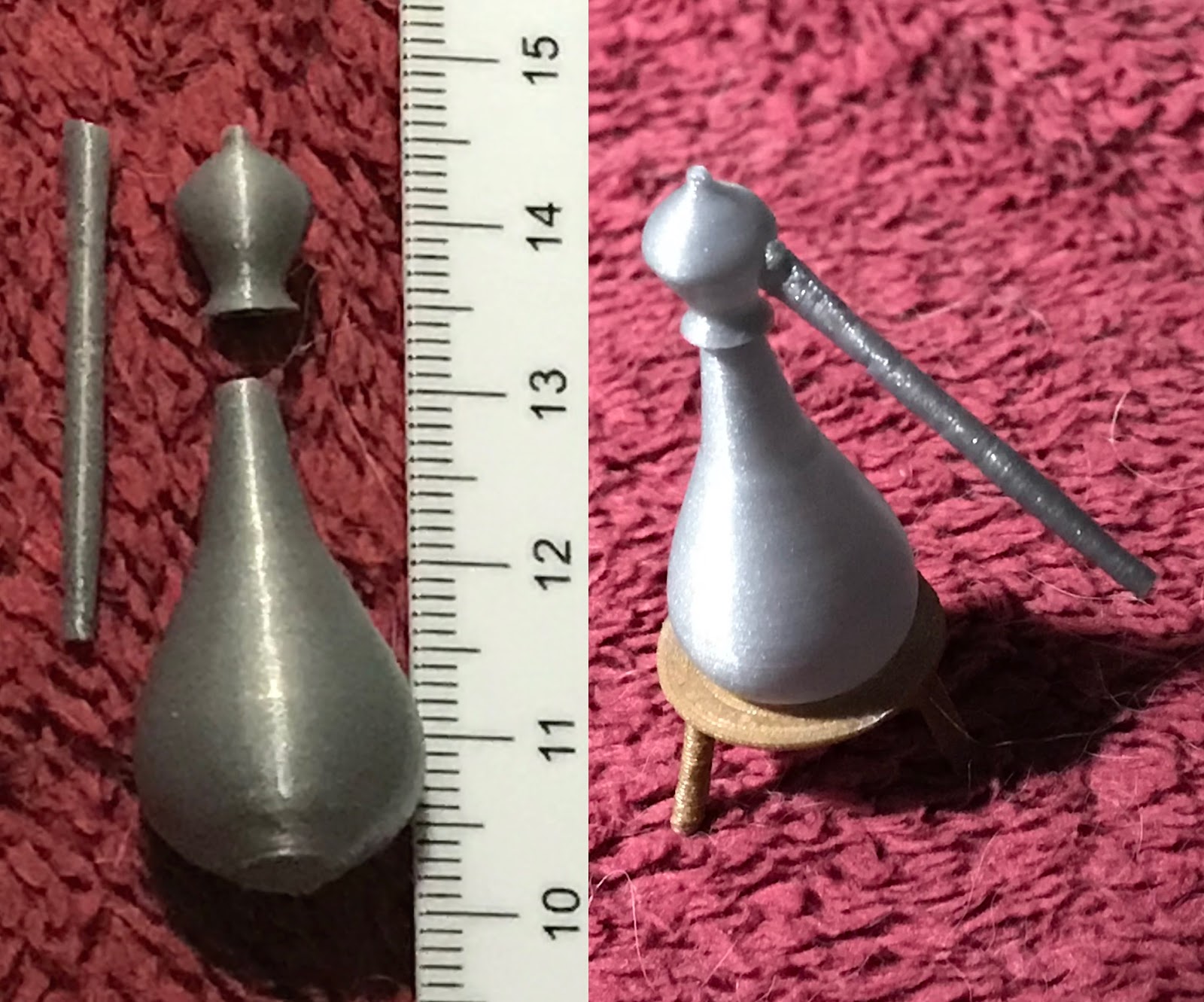
Some other items my husband 3D printed for me include scales (the chain was bought online), a brass mortar and pestle, and an alembic in 3 pieces (+ stand).

One of the first items I did was a mounted butterfly display. Two of the butterflies were made by putting light moulding paste into a butterfly nail art mould. I then coloured them with markers. The third was punched out plastic and also coloured. I made a frame with matchsticks and a piece of cardboard. One of the last things I made was a miniature magnifying glass made from 2 jewelry jump rings, a punched out circle of plastic and a piece of toothpick.

Click here to see the finished diorama! I've also set up an online album where you can see the work in progress with more images of the decorations and how I made them.

Saturday, 8 March 2014

Book Review: The Alchemy of Paint: Art, Science and Secrets From the Middle Ages by Spike Bucklow

Pros: very well researched, explains things clearly using numerous examples, goes over various historical traditions

Cons: only mentions the most expensive pigments artists used, only a few illustrations

This is an exploration of colours used by painters in the middle ages by way of their ‘scientific’ and alchemical significance.  It mentions myths, traditions, physical and spiritual significances of the materials according to Traditional beliefs.  It also goes over the alchemical procedures that made these already expensive pigments even more important.

I was expecting a treatise on all the different pigments used in the middle ages, something akin to a teaching manual.  Instead, I got a mind blowing exploration of philosophy and world beliefs of the past.  I’ve always been interested in alchemy, and this book explained things like Plato’s cave, 4 element theory, and the Philosopher’s Stone in a way that was easy to understand.  While there were only a few simple figure drawings, the clarity of the writing meant illustration wasn’t really necessary (even if it would have been welcome).

Only a few pigments are mentioned: Tyrian purple, ultramarine blue, vermilion and dragonsblood (both red), and gold.  Later chapters revisit some of these materials showing their spiritual, rather than physical, significance.  I appreciated learning that the location and method of obtaining materials had meaning for the later artwork and use of the pigments, which I hadn’t expected.  Similarly, it doesn’t cover all aspects of alchemy, just those associated with the pigments being discussed.

The opening’s a bit condescending in the way of ‘we don’t think as they did, so it will be hard for you to understand what I’m about to say’, but he quickly moved on to the topic at hand, and only occasionally gave a modern analogy for those who might have trouble wrapping their heads around the Traditional world view (as opposed to the modern Scientific, analytical view).


This is a fascinating book and if you have any interest in alchemy I can’t recommend it enough.  Another thing it showed, that modern audiences don’t recognize, is how interconnected the world of the past was.  We see Europe as an isolated area, ignoring the fact that materials and ideas traversed borders and continents to influence them.  I also didn’t realize just how much Christianity took from other traditions.  Looks like I’ve a whole lot more reading and research to do.