Showing posts with label Christianity. Show all posts

Tuesday, 19 November 2024

History Book Review: Going to Church in Medieval England by Nicholas Orme

This is a book about worship and attendance of the medieval church in England. Specifically, the book focuses on parish worship, that is, worship for the populace in villages and towns (as opposed to monasteries and cathedrals, where worship was for their members). It consists of nine chapters: Origins and the Parish, The Staff of the Church, The Church Building, The Congregation, The Day and the Week, The Seasons and the Year, The Life Cycle, The Reformation and Reflections.

It is a very detailed study and can be a bit dry at times. The breadth of information however, is incredible. The author researched numerous primary sources to get a broad idea of how people really responded to the church’s demands (tithes/taxes, holy days, weekly worship). Some were pious, others rebellious.

Rather than a chronological overview, the book tackles a subject and shows how it changed over time. I personally found the two chapters on liturgy and how it worked from day to day and over the course of the year (chapters 5 and 6) the most fascinating. It’s really hard to get a firm understanding of how church practice occurred beyond reading primary sources (like the missal or breviary), so a book explaining now only how the services went, but also how they differed as they year progressed was very helpful. The book includes a lot of details about various ceremonies (baptism, marriages, etc) as well.

There are a decent number of colour illustrations throughout the book.

I learned so much from this book. From seemingly simple things like the difference between a rector and a vicar, to how much medieval practice survived the Reformation’s attempts at reform. If you’re interested in the Catholic church, how churches were run in the middle ages, or liturgy and religious practices in England, you really need to pick this up.

Tuesday, 27 February 2024

Book Review: Strange Religion by Nijay K. Gupta

The book is split into 4 sections, with 12 chapters, an introduction, and a short conclusion. There are end notes at the back. The 4 sections are: Becoming Christian, What the First Christians Believed, How the First Christians Worshipped, and How the First Christians Lived.

I reviewed an advance reader copy, meaning it wasn’t in its final form. My copy had no illustrations, just captions where the illustrations should go. So I cannot comment on their quality, though there were a good number of them and they’re placed to illustrate interesting aspects of the text.

The author used a decent number of quotes from ancient texts in addition to numerous Old and New Testament quotes. He often tied things together with modern examples which I found a bit jarring but might help a general audience better understand the thought process of ancient peoples.

The book has some great aims and asks some excellent questions. These are questions that cannot be fully answered, as sources are limited, but it was frustrating at times how short the discussion was. The author might give a few possible answers but little or sometimes no reasoning on why these answers should be considered.

For example, in the 3rd chapter he questions why Romans would join the new Christian church when it was so radically different from what they were used to. He mentions 4 possibilities: the intriguing idea of monotheism, the promise of eternal life, that the new faith blended religion, philosophy and morality in a way others didn’t, and the concept of loving everyone. He mentions these but has no follow-up discussion about them and simply ends the chapter. Also strange is the absence of Christianity’s idea of equality as one of those possibilities. Many early adopters of Christianity were rich upper class women (women whose houses were gifted to the church to become buildings of worship upon their deaths). While upper class women had more agency than many in ancient Rome, the Christian faith gave them power over belief in ways other religions denied them. The author does cover the stratification of Roman society and how Christians tried to upend that with their idea of everyone being treated equally within the church in a later chapter, but he never posits this as a reason why lower class individuals might have joined the church in the first place. Even in his conclusion, when he again considers the question of what made Christianity so compelling, he neglects to mention it in favour of purely spiritual answers.

Despite my desire to see more discussion, the book is excellent at giving a good idea of how differently ancient peoples thought about concepts like religion. It was very useful learning how Greeks and Romans worshipped. I also appreciated learning more about how early Christian practice was different from the Jewish faith it sprang from. I highlighted numerous passages in the book that I thought were worth reflecting on. Christianity has changed a lot from those early years, so it was interesting seeing what the first Christians believed and how they followed Christ.

Consider this a great introduction to the topic of how early Christians practiced and how their worship and thought patterns differed from those of the people around them. It’s a fairly short, easy to read book that will give you a lot to think about.

Tuesday, 28 February 2023

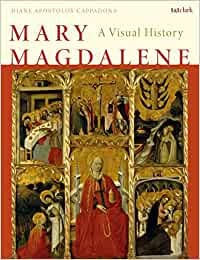
Book Review: Mary Magdalene: A Visual History by Diane Apostolos-Cappadona

Pros: lots of photos, highly informative

Cons: a bit repetitious

Mary Magdalene is a fascinating saint. From simple origins, a few mentions in the New Testament, to becoming amalgamated with other New Testament Marys, to having a variety of stories about where she spent her later years (Ephesus or France), being a sinner, a penitent, a preacher, a feminist icon, her story is constantly evolving.

The book starts with an introduction before separating into two parts. Part One: Towards a Visual History, consists of 7 chapters (Scripture Sources, Patristic Sources, Eastern Christian Narratives & Traditions, Western Christian Narratives & Traditions, Symbols & Devotions, Mary Magdalene through Christian Art, and Coda). This part examines what the scriptures say about the various Marys that were amalgamated into the story of Mary Magdalene and how ‘her’ story was depicted in art through the years. The second part, Motifs, consists of 10 chapters that analyzed specific aspects of Mary Magdalene, and how those were depicted in art (Sinner/Seductress, Penitent, Anointer, Weeper, Witness, Preacher, Contemplative, Reader, Patron, and Feminist Icon). These are short chapters, of 3 to 5 pages each, with 1 to 2 photographs highlighting their subject. The book concludes with an afterward that mentions exhibitions focused on Mary Magdalene and a select bibliography for further reading.

I found the introduction fairly repetitive and a bit harder to parse than the rest of the text. Part one had some great foundation information about how Mary’s story began and developed. It was really interesting seeing how parts of her legend came about. The chapters were thorough and easy to read. While each chapter in part 2 was short, the author packed a lot of great information into them, including mentions of her in early Christian and apocryphal writings. There’s some repetition here as well, though I suspect it’s so each chapter stands on its own. There were occasional page notes with sources for other articles and books to read for more information and a few explanatory notes.

The book has a lot of excellent colour photographs that demonstrate the points the author is making. They cover the variety of motifs Mary Magdalene was used to represent, as well as the various periods during which she has been worshipped.

If you’re interested in Christian saints in general or Mary Magdalene in particular, it’s a fantastic book.

Wednesday, 14 April 2021

Book Review: Satan: The Early Christian Tradition by Jeffrey Burton Russell

Pros: detailed analysis, lots of explanation

Cons: lots of necessary repetition

This is the second in a series of books on the evolution of the devil in Christian thought, following The Devil: Perceptions of Evil from Antiquity to Primitive Christianity (reviewed here). There are 8 chapters: The Devil, The Apostolic Fathers, The Apologetic Fathers and the Gnostics, Human Sin and Redemption: Irenaeus and Tertullian, Mercy and Damnation: the Alexandrians, Dualism and the Desert, Satan and Saint Augustine, Conclusion: Satan Today. There is also an essay on the sources used by Russell.

Given that each group of theologians built on what came before, the book contains a lot of repetition. Several later authors expanded on Origen’s theory of the cosmos and redemption before it was declared heretical. Russell does a good job of explaining sometimes convoluted mythologies (like those of the Gnostics and Manicheans) so that you can see how their beliefs coloured that of Orthodox Christians.

Each chapter deals with a stage in the development of Christianity, including how the believers at that period understood Creation, the Fall (of angels and mankind), and Redemption (whether through Christ’s sacrifice or via tricking the Devil). It’s interesting to read the various theories and how they shifted and grew over time into the ideas we’re familiar with today.

While it’s an older book, first published in 1981, the scholarship is solid, with then current references and a lot of page notes explaining certain concepts in more detail.

If you’re interested in the development of the devil and hell, how theological discourse changes over time, or simply in the history of Christianity as a whole, this is an interesting read.

Tuesday, 28 January 2020

Book Review: The Devil: Perceptions of Evil from Antiquity to Primitive Christianity by Jeffrey Burton Russell

Pros: very thorough, lots of endnotes

Cons: not many photos 

This was a very interesting book about how peoples in the past thought about the concept of evil and how those philosophical musings and religious beliefs slowly morphed into the idea held by Christians that there is a single force that causes evil: the Devil.

After the preface the book consists of 7 chapters: The Question of Evil, In Search of the Devil, The Devil East and West, Evil in the Classical World, Hebrew Personifications of Evil, The Devil in the New Testament, and The Face of the Devil. There’s a select bibliography and an index.

The book starts with a discussion of what evil is. This book traces how ancient societies thought of ‘evil’, whether it was part of the gods, human nature, imposed from the outside or something within us. It examines both religious and philosophical beliefs from various cultures and periods whose peoples wanted to know why good things happened to bad people. Why, if there’s a god (or gods) who is good, who created a world of good, is there evil in the world?

We’re so used to categorizing things that it’s easy to forget just how interconnected the world really is. I tend to think of Greek mythology as independent from other religious practices, even though I know the Romans modified the beliefs to fit with their own pantheon of gods. So it was eye opening learning how the Greek gods were turned into evil spirits by early Christian thought, and how Pan was used as a template when artists started visualizing the devil as a personification of evil.

I only knew bits and pieces of other ancient religions so leaning more about them and how they intersected and built off of one another was fascinating. I also loved learning side information like why people with red hair were considered evil.

The most interesting section for me was on the Persian Zoroastrian religion, whose basic mythology is similar to the one Christianity ultimately settled on. I also enjoyed learning more about the apocalyptic Jewish writings and how they impacted the Gospels in the New Testament. 

There aren't that many photos, but the ones included help visualize how the devil gained certain attributes (like wings, horns, etc). 

This is an older book (it came out in 1977), but it’s still highly relevant to Christian and general religious studies.