Showing posts with label History. Show all posts

Friday, 22 May 2026

History Book Review: Treasures of the Vikings by Tom Horne

The book has 7 chapters in addition to the introduction: Playing games: growing up a viking; Production and consumption; House and home; Clothing and adornment; Weapons and war; Trading and raiding; Faith and death. There's an index, a bibliography and picture credits at the end.

The book is heavily illustrated with each chapter having numerous pictures of relevant archaeological finds. It emphasizes the ubiquity of viking culture despite its geographic expansion. I loved the inclusion of so many items from daily life.

The chapters are fairly short, covering a decent amount of information in a superficial way. It's a nice introduction to the life of Vikings, but if you've researched the topic before you won't learn much new.

While the book has information about the objects depicted, and credits for the included photographs, I often wanted to know where the objects were currently housed and that's hard to figure out. Some of the photos are credited to institutions where they're presumably held, but others have Alamy or individual photographer credits, which is less helpful. I may be in the minority for wanting this information though.

It's a great primer on Viking life.

Tuesday, 3 March 2026

History Book Review: Ancient Nubian Art: A History by Rita E. Freed

The book consists of 8 chapters in addition to the introduction: Beginnings; Expanding World: A-Group; C-Group and Pan-Grave Cultures Move In; Nubia’s First Empire: Kerma; An Interlude with Egypt; Nubia’s Second Empire: The Napatan Period; Nubia’s Third Empire: The Meriotic Period; and Beyond the Meroitic Empire. There’s a forward by Henry Louix Gates, Jr. that explores what Nubia and Egypt meant to enslaved Africans in America, and why learning about ancient African nations and their accomplishments was so important to black Americans.

The book follows the chronological history of Nubia, as we can piece it together through archaeological evidence. The early chapters are fairly short, as there isn’t much evidence or material objects. There are at least a few photos per chapter illuminating the text. The chapters get more detailed as empires rose, since they left significantly more behind. The book constantly compares the artwork, homes, clothing, and habits (as well as can be determined) to the more well known Egyptian one. So we’re told that Egyptian artwork is more formulaic, while Nubian artwork has more of a naturalistic look, with freer forms and curvier figures. I was especially interested to learn the ways Nubian metalworkers experimented with enamel to create mixed forms much earlier than appeared elsewhere in the world.

In addition to images of artworks, the book also has some floor plans for palaces and temples, diagrams of houses, etc.

It’s fascinating learning about such a little known culture. Their artwork deserves to be known in its own right, separate from that of Egypt. Hopefully this book will encourage people to learn more about the Nubians and their culture.

Tuesday, 4 February 2025

History Book Review: Winters in the World: A Journey through the Anglo-Saxon Year by Eleanor Parker

The book details the seasonal beliefs and festivals of the Anglo-Saxons by examining each season and some of its special aspects. After the introduction each season has 3 chapters breaking down it’s most important aspects, followed by references and bibliography.

This is a fascinating book. It’s interesting seeing how daily life changed with the season but the author does so much more. She examines how the Anglo-Saxons FELT about each season, like how winter ice kept them landlocked and trapped. She goes over various terms they used for the seasons and holy days, if and how those changed with the coming of Christianity. To the extent that the primary sources allow, she also details how various holy days were celebrated

There are lots of quotes from various Anglo-Saxon works. I learned about a few new sources I’d like to look up. There are no illustrations in the book, but it doesn’t really need them. This isn’t a visual tour, it’s an intellectual and emotional one.

I found this an interesting book that taught me a lot about how Anglo-Saxons thought about the world and how they lived and celebrated throughout the year.


Tuesday, 24 September 2024

VIdeo: The Magic Ring of Hermes Ritual

Dr. Kirsten Dzwirza is an archaeologist studying Egyptian, Greek, and Roman magical writings and artifacts. She's working on a sourcebook with new translations of a lot of magical spells and inscriptions and has been making the occasional youtube video about her work. (Her channel is called The Archaeology of Ancient Magic & Ritual Practice, in case the links stop working.) I wanted to embed a recent video she made about the ritual for making the magic ring of Hermes from the Greek Magical Papyri, but I am unable to. It's worth heading to youtube to see it HERE. She's also made a free online course explaining what the Greek Magical Papyri are.

Tuesday, 2 July 2024

Book Review: Chronicle of the Czechs by Cosmas of Prague

Translated by: Lisa Wolverton

This is meant to be a history of the Czech people, from its origins (via legend about the land’s native inhabitants, the Lucane) until Cosmas’s death. It’s broken up into 3 ‘books’. The first deals with the “deeds of antiquity”, that is, information Cosmas got from outside sources to tell of events he wasn’t alive for. Book 2 begins with the reign of Duke Bretislav in 1038 and ends with the crowning of Duke Bretislav the Younger in 1092. The last book goes until the death of Cosmas in 1125, and tells more detailed stories of deception as brothers and cousins fight for the Dukedom. It also mentions several notable weather events (eclipses, floods, heavy snows, etc).

It’s an interesting chronicle, especially after reading the introduction and with the explanatory notes. There were times when I thought it was a really interesting piece of history only to learn that the author inserted a story from a Chronicle of earlier times, simply changing the names to fit the current protagonists. That is, a decent amount of the 1st book is made up or recycled stories rather than an attempt to tell legitimate history as we understand the term. There were also sections that got confusing, so if you’re not paying close attention you can get very lost regarding who’s who and what people are fighting over.

The entries vary from being dry and frankly boring to being lively and interesting. It also goes from in depth stories with dialogue and description to a single line saying someone previously unmentioned has died.

For the most part the page notes were very helpful. There were times when I wanted more information from them. They generally gave clarifying information (this is king ‘x’ of country, who lived date to date) or give a citation of what text Cosmas is quoting. Sometimes the text mentioned interesting side information that I wanted to know more about. A few times I looked up people mentioned to learn more about them, like Matilda of Tuscany.

Cosmas’s view of heroic and villainous is often not what I would have expected for a cleric. He praises the goodness of one man who abducts a noblewoman from a convent and marries her. He has a real disregard for the land’s original inhabitants and the Poles, who come up a lot. Sometimes he calls men using deception to gain power wolves among sheep. Other people who do similar things get praised for being clever. There are a few anti-semitic passages.

It’s always interesting to see what people in the middle ages thought worth preserving in terms of history - especially when it comes to nation building. While this won’t be for everyone, it’s great to have such resources translated into English to learn more about the history of the Czech region.

Tuesday, 28 May 2024

Book Review: Handbook for William by Douda

Translated by: Carol Neel

This is a translation of a booklet of instruction written in the late 840s by an ill noblewoman for her older son, William. It was a difficult time for her. William was a hostage against her husband’s good behaviour. Her husband had taken their infant son to an unknown location, leaving her to run their lands alone. There’s a measure of sadness in the prologue, as it’s clear Dhouda believes she will die without seeing her sons again.

The text is designed to teach her son(s) the things she would not be able to (either due to her death and/or their separation). It gives advice for how to navigate the world as a man of rank as well as advice on spiritual and moral behaviour.

The section on mathematics was interesting as it’s less about calculations and more on the spiritual meaning behind numbers.

There’s some repetition in what’s being said and the book can be boring at time. Still, it’s interesting to know what a woman believed her son needed to know to be a success and how she thought men of her station should behave.

Medieval writers often quote Bible verses and other texts without giving the source or any context. So, for example in book 4, section 7, Douda councils her son to be calm like the man “who rules almost six hundred thousand people and who we read was never disrupted by anger”. He’s named, Moses, a few paragraphs later, but it seems clear that Douda expected her son to know the reference and the man it refers to. I’ve often wondered the extent to which Biblical stories were known by non clergy. Now this was written at a time of enhanced education and by an aristrocratic wealthy woman who clearly had a decent education, so maybe the expectations are understandably high here.

If you’re interested in medieval thought, behaviour, or education, this is a worthwhile read.

Tuesday, 21 May 2024

Video: What it was like to visit a medieval tavern

This is an interesting video by Tasting History with Max Miller on what medieval inns, taverns, and alehouses were like. He even teaches how to make a medieval meat stew.


Tuesday, 27 February 2024

Book Review: Strange Religion by Nijay K. Gupta

The book is split into 4 sections, with 12 chapters, an introduction, and a short conclusion. There are end notes at the back. The 4 sections are: Becoming Christian, What the First Christians Believed, How the First Christians Worshipped, and How the First Christians Lived.

I reviewed an advance reader copy, meaning it wasn’t in its final form. My copy had no illustrations, just captions where the illustrations should go. So I cannot comment on their quality, though there were a good number of them and they’re placed to illustrate interesting aspects of the text.

The author used a decent number of quotes from ancient texts in addition to numerous Old and New Testament quotes. He often tied things together with modern examples which I found a bit jarring but might help a general audience better understand the thought process of ancient peoples.

The book has some great aims and asks some excellent questions. These are questions that cannot be fully answered, as sources are limited, but it was frustrating at times how short the discussion was. The author might give a few possible answers but little or sometimes no reasoning on why these answers should be considered.

For example, in the 3rd chapter he questions why Romans would join the new Christian church when it was so radically different from what they were used to. He mentions 4 possibilities: the intriguing idea of monotheism, the promise of eternal life, that the new faith blended religion, philosophy and morality in a way others didn’t, and the concept of loving everyone. He mentions these but has no follow-up discussion about them and simply ends the chapter. Also strange is the absence of Christianity’s idea of equality as one of those possibilities. Many early adopters of Christianity were rich upper class women (women whose houses were gifted to the church to become buildings of worship upon their deaths). While upper class women had more agency than many in ancient Rome, the Christian faith gave them power over belief in ways other religions denied them. The author does cover the stratification of Roman society and how Christians tried to upend that with their idea of everyone being treated equally within the church in a later chapter, but he never posits this as a reason why lower class individuals might have joined the church in the first place. Even in his conclusion, when he again considers the question of what made Christianity so compelling, he neglects to mention it in favour of purely spiritual answers.

Despite my desire to see more discussion, the book is excellent at giving a good idea of how differently ancient peoples thought about concepts like religion. It was very useful learning how Greeks and Romans worshipped. I also appreciated learning more about how early Christian practice was different from the Jewish faith it sprang from. I highlighted numerous passages in the book that I thought were worth reflecting on. Christianity has changed a lot from those early years, so it was interesting seeing what the first Christians believed and how they followed Christ.

Consider this a great introduction to the topic of how early Christians practiced and how their worship and thought patterns differed from those of the people around them. It’s a fairly short, easy to read book that will give you a lot to think about.

Tuesday, 26 September 2023

History Book Review: Magic in the Roman World: Pagans, Jews and Christians by Naomi Janowitz

The book focuses on how magic was viewed in the first Christian centuries. It has 6 chapters in addition to an introduction and conclusion. They are: 1) Greco-Roman, Christian and Jewish concepts of “magic”, w) Daimons and angels and the world of exorcism, 3) Ancient rites for gaining livers, 4) Using natural forces for divine goals: Maria the Jewess and early alchemy, 5) Divine power, human hands: becoming gods in the first century, 6) “Even the decent women practice witchcraft”: magic and gender in late antiquity.

It’s a relatively short book that gives a good introduction to the topic. The author emphasizes several times how modern definitions of the word ‘magic’ don’t match those of the past, and that we therefore have to be careful both with how we approach the topic and - if reading works in translation - how the translators may have taken innocuous words and forced a negative view on them (for example some Greek words in themselves have no magical connotations, but some translators have added the word ‘magic’ to them). Similarly, sometimes later writers objected to earlier forms of practicing their own religion, as with some people who edited the Hebrew Bible, and wrote in condemnations of what had been normal Jewish religious practices.

There are some interesting ideas here. The religious rituals of those who practiced differently were often termed magic. This could have political and therefore propagandistic purposes. The term magic comes from the Persian word ‘magos’, meaning priest. The Persians were the military enemies of the Greeks. Magic was considered bad because it worked, and worked via evil spirits rather than through the correct ‘god’ (that is, the deity the author of each specific source text followed). Thus, Romans and Greeks called Moses and Jesus “magicians” [this isn’t in the book but there are some fabulous Christian sarcophagi in the archaeological museum in Arles that show Jesus performing miracles using a magic wand, so it seems early Christians weren’t as horrified by that idea as modern Christians would be].

The book covers a decent range of topics including alchemy and deification of humans. It was interesting seeing some of the rationale behind the belief that Roman Emperors became gods after death and how some religious practitioners of other faiths tried to ascend and become like gods themselves.

The author does a good job of exploring the subject of each chapter from the Greco-Roman, Jewish and Christian viewpoints. Sometimes spending more time on one group than the others, but showing how complex the notions of magic and religion were in the ancient world.

There are no photos in the book which seems a shame.

If you’re interested in ancient religions and magic, this is a quick but useful jumping off point for more in depth studies.

Tuesday, 30 May 2023

Book Review: A History of Magic, Witchcraft, and the Occult by DK

Pros: lots of information easily digested, plentiful photographs, varied topics

Cons: I feel like there was more magic from the African continent that deserved mention

The book has 5 sections, each broken down into numerous subchapters going into more detail. The sections are: Ancient roots (prehistory to 400 CE), Curse or Cure (400-1500), Scholars and Sabbats (1500-1700), Secrecy and Ceremony (1700-1900), and Modern Magic (1900 onward). There is also a glossary at the back of the book. I was impressed by the number of subsections there were and how thorough the coverage is both in terms of history and geography.

Most topics got a 2 page spread, with a few getting 4 pages. Occasionally side information would get its own spread, like images of fetishes or amulets from different cultures or the meanings of rune stones and how to use them for divination.

I would have liked to learn more about indigenous African beliefs. The authors did a good job of trying to differentiate between magical practices, superstition, and religions still being practiced (which only showed up as they intersected with magical practices, like the Christian persecution of witches). I was impressed by the sheer breadth of information covered. Much of it I was familiar with, but there were sections, like Finnish native beliefs that I had never heard about.

There are a lot of excellent photographs and good use is made of box text diving into specific practices and practitioners that needed a bit more coverage.

I didn’t expect the modern sections to interest me as much as the ancient and medieval sections, but it was fascinating to see some practices return and others morph over time.

If you’re looking for a broad overview of magical practices, this is an excellent book.

Tuesday, 18 April 2023

Video: Monk's Modern Medieval Cuisine

I recently stumbled across a new youtube channel: Monk's Modern Medieval Cuisine. The idea is to offer 'easy' medieval recipes. I watched several of his videos and would love to try some of these myself. I love how Dr. Monk tastes the food at the end, giving some idea of what it tastes like, and thoroughly enjoying himself.

Tuesday, 28 March 2023

Book Review: Medieval Plants and Their Uses by Michael Brown

Pros: lots of great information, good amount of coloured photographs

Cons: hard to source quotes

The book has 15 chapters including the introduction: Medieval Vegetables; Medieval Fruits & Nuts; Grains; Plants & Medicine; Symbolism and superstition; Magical & Mysterious; Love, Seduction & Beauty; Childbirth, Babies & Nursemaids; Clothing, Laundry & other Household Tips; Dyes, Inks & Paints; Animal Health Care; Harvesting & Preserving Plant Material; Fun things to do; Plant Lists. It would be impossible to give a full accounting of the uses of plants in the middle ages in such a short book. The author does an admirable job of giving a lot of information in such a condensed format. I was impressed with how many plants he dealt with in even the shorter chapters, with lots of tidbits of folklore added in. Medicine gets the longest chapter as it goes over specific ailments and what plants were used to treat them.

The book has a lot of half page and full page colour photographs of plants and some manuscript illuminations. These are used to good advantage when explaining how certain plants were used based on their looks (like a photo of henbane next to its use in curing toothache as the seed cases resemble teeth on a jawbone). The rose sepal photo really helps explain a poem used in the symbolism and superstition chapter.

There are a number of recipes included, though the author does advise against using some, especially in the medical section.

The chapter on fun things to do shows several ways to make flower crowns and a few simple reed instruments.

I loved learning about plants I’ve never heard of, including several vegetables that are no longer widely cultivated as the easier to grow and cook potatoes have taken their place. It was also interesting learning how medieval people may have dealt with things like chapped lips or dying hair. Another fun tip was to chew licorice for a clear voice, the way Roman orators did.

There’s a bibliography at the end of the book but no citations or notes in the text explaining what source specific information is from.

This is an easy to read guide on medieval plants including a lot of great information.

(Out March 30)

Tuesday, 9 August 2022

Not a Review: From Age to Age by Edward Foley

This isn't a proper review because I only had time to read select chapters of interest.

When I did my degree in medieval studies I learned about languages, manuscripts, church architecture, drama, literature and philosophy. It shocks me now that not one professor suggested learning about Catholicism and how the church's liturgy affected architecture, etc. The first inkling I had that I'd missed something massively important was during my graduation mass (the first time I attended mass), and so many things suddenly clicked. Recently I've been trying to plug that gap in my knowledge and came across From Age to Age: How Christians Have Celebrated the Eucharist.

The book has an introduction followed by 7 chapters: 
1. Emerging Christianity: The First Century
2. The Domestic Church: 100-313
3. The Rise of the Roman Church: 313-750
4. Frankish Domination: 750-1073
5. The Prelude to Reform: 1073-1517
6. Revolt, Reform and Rigidity: 1517-1903
7. The Return to Change: 1903 and Beyond
The book concludes with a glossary and bibliography.

Within each chapter the author subdivides the information into categories for architecture, music, books, and vessels for administering the Eucharist.

The book explained terms I've seen for years without properly understanding them (for specific books and liturgical vessels in particular), as well as giving some indications as to how the space in a church was used over time (the development of the choir, the slow exclusion of the congregation from singing/participating).

If you don't know the difference between a missal and a breviary, or what a pyx is, this is an easy to read primer that covers the whole of Catholicism. It doesn't go into a lot of detail, but it gives a good foundation.

Tuesday, 19 July 2022

Book Review: The Fabric of Civilization: How Textiles Made the World by Virginia Postrel

The book consists of seven chapters with a preface and afterward. Each chapter deals with a particular part of fabric production: Fiber, Thread, Cloth, Dye, Traders, Consumers, and Innovators. Each chapter starts in ancient times and ends in modern ones, showing how things have changed over time.

Fabric is one of those things that is so ubiquitous and important for life, and yet is also so ordinary and cheap nowadays that we simply forget about it. The book emphasizes that for most of human history fabric was at the forefront of thought. The amount of time and effort that’s gone into clothing and cloth for other purposes (sails, table coverings, curtains, blankets, etc.) is astronomical.

The book begins with the idea that modern people look at ancient art dealing with women and see a spindle and think, ah, this is a domestic scene. But we forget that the spindle as a means of turning fibres into thread was the start of production, necessary for the home, yes, but also an important industry. Millions of women over the course of history have spun thread and made cloth, whether of flax, cotton, wool, or silk. It was constant work because cloth is always needed. The book also shows how spinning thread was undervalued, partly because it was women’s work, but also because the higher the cost of thread, the higher the cost of cloth. We do the same thing today, keeping the final cost of clothing low so the rich can buy a lot of it, even if that means exploiting the workers who sew the cloth into clothing.

My interests are in ancient and medieval history so I didn’t expect the modern sections to interest me, but they were also fascinating. Learning about how cotton plants were cross bread and a fluke mutation created the cotton plants bred today was neat.

This is an excellent book dealing with a topic that affects everyone, but to which we give entirely too little thought.

Tuesday, 7 December 2021

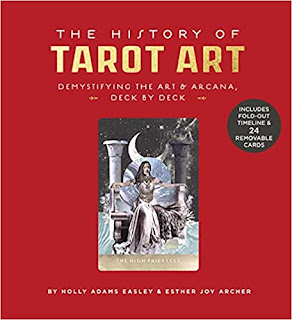
Book Review: The History of Tarot Art: Demystifying the Art and Arcana, Deck by Deck by Holly Adams Easley and Esther Joy Archer

Pros: lots of illustrations, sticks to verifiable history, engaging

Cons: images of a few discussed cards not included

Note: I received a review copy of the ebook from Netgalley and therefore cannot comment on the removable Sola-Busca tarot cards or fold-out tarot timeline that the physical book comes with.

The History of Tarot Art takes you on a journey of the most influential tarot decks. After a short introduction there are 12 chapters on specific tarot decks, followed by a chapter that showcases several contemporary decks. Then there’s a quick epilogue and an appendix where the authors explain how to do a tarot reading and provide 2 spreads for beginners.

Each chapter talks about the history of that deck, who the artist was and why the deck was created. In a few cases other artworks by the artist are included so you can see their general style. The artists also explain the wider influence of the decks and offer a few suggestions of other decks you might like if that style of art speaks to you.

In the introduction the authors make it clear that they are only including verifiable history, no ‘fakelore’. I really appreciated the amount of research that went into this book and how ideas about tarot developed from playing cards to cards for divination purposes.

There are a lot of illustrations in the book, mostly specific tarot cards from the decks discussed and recommended. In a few places the authors spoke about specific cards that did not show up in the book, which was unfortunate. There were also a few places where the formatting of the book meant the authors spoke about one specific card, like the sun card, and a different deck’s sun card appeared on that page, which was a bit confusing.

It’s fascinating to see how styles changed over time and how various artists created their own decks to address the fact that the current decks didn’t speak to them or show them as practitioners (so feminist and more inclusive decks that made the esoteric content more accessible).

On the whole this is a fantastic book if you’re interested in the art and history of tarot cards.

Tuesday, 24 August 2021

Book Review: The Good Wife’s Guide - Translated by Gina Greco and Christine Rose

Pros: faithful translation that mentions prior work done on the text, lots of textual notes and introductory pieces to help with comprehension, lots of interesting information about life in the middle ages

Cons: medieval writing tends to be dry and I found it hard to read more than a few pages at a time without a break

This is a translation of the French medieval household book Le Ménagier de Paris. It consists of an introduction, which includes background information, what life was like in Paris at the time of it’s writing, and a gloss of The Tale of Griselda. The text itself consists of several parts talking about good conduct (prayer, behaviour, dress, chastity, virtues & vices, obedience to one’s husband, etc), horticulture, choosing servants, hawking, menus, and recipes. There are introductory passages every few sections so you have a good idea of what the book will discuss next, as well as excellent page notes (many of which detail translation decisions) and a very useful glossary of culinary terms to help with the last 2 sections of the book and a bibliography.

The premise of the text is that of an older husband writing a book for his new young wife so that she will be properly trained and able to manage a household for her second husband after the author’s death. The book goes into a fair amount of detail regarding some items (there are a lot of recipes and detailed information on the virtues & vices, breaking down the various ways people sin and how it’s important to confess). There are also some long morality tales about how it’s important to obey one’s husband and be long-suffering, even if your husband tries your patience or tests you.

I found it very interesting what a woman in 14th C Paris was expected to know, even if it’s unknown if the author’s ‘young wife’ actually existed. The cooking section mentioned where to buy certain ingredients and how much they cost. The hawking section was very detailed about how much work was involved, all of which had to be done by the person intending to fly the hawk (so servants couldn’t train the bird for you). The moralistic tales are fairly long winded and get boring after a while. The Tale of Griselda is kind of infuriating as a modern reader and even the author’s response to it implies he doesn’t agree with the husband’s actions, but thought it was worth including anyway.

I wish the author had finished his planned book and included the games and entertainments he’d intended. I think those might have been quite interesting to learn about.

There’s a lot of great information here, but you’ll probably have to read it in small doses to stay engaged. The translators did a fantastic job of keeping the language easy to understand, but medieval texts tend to be on the dry side.

Tuesday, 22 June 2021

History Book Review: Bread, Wine and Money: the Windows of the Trades at Chartres Cathedral by Jane Welch Williams

Pros: very detailed analysis, excellent overview of the history required to understand the author’s thesis, lots of images

Cons: some images are of poor quality, some ideas/terms could have used a bit more explanation

It’s become conventional knowledge that the trade windows at Chartres and other cathedrals were donated by members of the trade guilds that are depicted. Williams has done a thorough job in this book, published in 1993, of refuting that claim.

The book is separated into 5 chapters, with an additional introduction and epilogue. There are 4 colour plates and 151 black and white plates. There are extensive notes and a bibliography. Chapter 1 briefly examines the literature that’s been written about Chartres cathedral with regards to its stained glass (dating and program), specifically focusing on interpretations regarding the trade windows. Chapter 2 goes over the historical circumstances in Chartres around the time the cathedral was built. It details the tensions between the chapter, the bishop, the count and the townspeople (including a riot in 1210). Chapters 3-5 are analyses of windows dealing with bread, wine, and money changers in that order. They each go over what other historians have said about the windows, the historical context of those trades (bakers, tavern keepers, and money-changers) then analyzes each window that shows those trades comparing them to others within the cathedral, to those from other cathedrals, and ancient Roman works.

Williams points out very quickly that there are few if any contemporary records supporting the idea the trade windows were guild gifts. Her very thorough examination of the interrelationships of power, and how bread, wine & money (that is the cash economy as well as monetary gifts to the cathedral) were incorporated into liturgical practice within the cathedral as well as the liturgical year (in terms of taxes and ‘gifts’). The book also examined how practices changed over time (for example, how the Eucharist was given less often to regular people and eulogy bread was passed out instead).

There were a lot of black and white images, including several useful maps and floor plans of the cathedral showing where the various windows were located in the building. Some of the window photos were of poor quality so it was hard to see what the author was describing (though this is probably due as much to the state of the windows at the time the book was made).

I did find that a few terms and ideas could have used a bit more explanation. For example, the author seems to assume that the reader knows that bishops were appointed from outside the Chartres chapter rather than voted on by the canons, which likely added to the antagonism between him and the canons.

I learned a lot about church practices and how various groups in society related to each other. It’s a great reminder that people have always been complex and relationships never easy, especially where power and money are involved.

If you’re interested in the middle ages, medieval art, cathedrals or liturgical practices, this is an interesting book and, I think, proves the point the author is making. It’s given me a lot to think about with regards to how I read church windows.

Tuesday, 11 May 2021

Book Review: Lucifer: The Devil in the Middle Ages by Jeffrey Burton Russell

Pros: quite thorough in some areas, decent number of images, very interesting subject matter

Cons: fair amount of repetition, some sections could have been fleshed out more

This is the third book in Russell’s history of the devil, following The Devil: Perceptions of Evil from Antiquity to Primitive Christianity and Satan: The Early Christian Tradition. (Click the titles to read my reviews of them.) It examines the development of the history and figure of the devil during the middle ages, considering issues like when and why he fell, what he looks like, what his powers are, his role in the fall of mankind and its subsequent salvation by Christ, and whether God is ultimately responsible for the devil's actions. 

The book has 11 chapters: The Life of Lucifer; The Devil in Byzantium; The Muslim Devil; Folklore; Early Medieval Diabology; Lucifer in Early Medieval Art & Literature; The Devil and the Scholars; Lucifer in High Medieval Art & Literature; Lucifer on the Stage; Nominialists, Mystics, & Witches; and The Existence of the Devil. The book also has an essay on the sources used, a bibliography and an index.

Due to the nature of the topic and how people and institutions wrote either building on the past or opposing the writings of others (writings that were deemed heretical), there’s a fair amount of repetition. It’s really interesting seeing the slow development of ideas. The book focuses mainly on the timeline of the fall of the devil & the evil angels (at the time of creation, sometime later) and the image and powers of the devil.

I’d have liked longer chapters on the Muslim devil and Byzantium as I don’t know as much about those areas of belief and his examination of them was very superficial.

The book includes a decent number of black and white photographs to help visualize the subject matter.

The section on witches was interesting as it focused on how preachers kept the fire and brimstone ideas of the devil alive even as theological discourse around evil was slowly letting ideas of the devil fade in importance.

The book pointed out a lot of interesting information about how Christian thinkers in the middle ages approached ideas of evil, the devil and God’s omnipotence. Despite the level of repetition, it’s a fascinating book.

Wednesday, 14 April 2021

Book Review: Satan: The Early Christian Tradition by Jeffrey Burton Russell

Pros: detailed analysis, lots of explanation

Cons: lots of necessary repetition

This is the second in a series of books on the evolution of the devil in Christian thought, following The Devil: Perceptions of Evil from Antiquity to Primitive Christianity (reviewed here). There are 8 chapters: The Devil, The Apostolic Fathers, The Apologetic Fathers and the Gnostics, Human Sin and Redemption: Irenaeus and Tertullian, Mercy and Damnation: the Alexandrians, Dualism and the Desert, Satan and Saint Augustine, Conclusion: Satan Today. There is also an essay on the sources used by Russell.

Given that each group of theologians built on what came before, the book contains a lot of repetition. Several later authors expanded on Origen’s theory of the cosmos and redemption before it was declared heretical. Russell does a good job of explaining sometimes convoluted mythologies (like those of the Gnostics and Manicheans) so that you can see how their beliefs coloured that of Orthodox Christians.

Each chapter deals with a stage in the development of Christianity, including how the believers at that period understood Creation, the Fall (of angels and mankind), and Redemption (whether through Christ’s sacrifice or via tricking the Devil). It’s interesting to read the various theories and how they shifted and grew over time into the ideas we’re familiar with today.

While it’s an older book, first published in 1981, the scholarship is solid, with then current references and a lot of page notes explaining certain concepts in more detail.

If you’re interested in the development of the devil and hell, how theological discourse changes over time, or simply in the history of Christianity as a whole, this is an interesting read.

Thursday, 8 April 2021

Video: Meet some of the last papyrus makers in Egypt

 I saw papyrus for the first time in 2019 on my trip to Ethiopia. It's a beautiful plant and an important historical skill. I'm glad to hear there are people keeping papyrus paper alive and hope the industry recovers quickly when the pandemic ends.