Showing posts with label world-building. Show all posts

Friday, 5 May 2017

Manjar blanco vs dulche de leche

I picked up a container of manjar blanco in Peru and wanted to see how it compared (or if it was the same as) the dulche de leche I got at the local grocery store. Online sources tell me that both are made by boiling milk and adding sugar, so my expectation is that they’ll be pretty similar. 

Opening the packages, it’s clear they’re not the same stuff. Dulche de leche smells like the caramel you get when you heat sweetened condensed milk (which, I learned when I looked it up, is how recipes suggest making it). Manjar blanco smells more like the caramel you get as an ice cream topping. 


The manjar blanco spreads more like peanut butter and is matt, while the dulche de leche is shiny and spreads thinner, more like jelly.


The taste was like the smell, with one having a more milk flavour and the other a richer caramel taste. It's strange that foods that are so similar can turn out so different.

So why am I mentioning this on my SFF blog? Because it's easy to forget when creating new worlds just how many minute differences between communities there are. There's this idea that everyone in your city or country or planet speaks the same, eats the same, worships the same. A great way to make your world feel real is to have characters point out that the food isn't quite the way they do it back home - spicier, richer tasting, more watery, fewer ingredients, etc. 

Food is a comfort. It reminds us of home and - hopefully - safety and love. And people complain about it all they time. They also praise it when it's exceptional and comment on it when it's unexpected. New foods when travelling can be an adventure all they're own, and when we're done travelling, they can also remind us of the places we've been, the things we've done and the people we've met. As such, it could be a great way to start a sequel, having a protagonist eating a dish that reminds them of the events of the previous book. The meal doesn't have to go uninterrupted of course. 

Friday, 14 October 2016

Honey Kvas Monastyrskiy

I’ve wanted to try mead for several year, despite the fact that I don’t like the taste of alcohol. I was able to try mulled wine in France, which to my surprise I really liked, and keep hoping that mead - another traditional medieval drink - will work for me.

The problem, of course, is few people make mead.

Going through the drinks section of my local grocery store I came across this:

Honey Kvas Monastyrskiy

For some reason, I got it into my head that this would be like mead.  It references honey - mead is made by fermenting honey - and it said ‘monastery’, and mead was traditionally made in monasteries.

So I bought it.

And it tastes pretty good! It’s got a bit of a malt flavour, but with a hint of honey. It’s sweet, but not overly so. I found the flavour complex and pleasant. It's also carbonated, which I liked. My husband had a hard time even sniffing the glass. I forced him to try a sip and that was enough for him! 

Looking it up online. Wikipedia had this to say:

Kvass is a traditional Slavic and Baltic fermented beverage commonly made from black or regular rye bread. The colour of the bread used contributes to the colour of the resulting drink. It is classified as a non-alcoholic drink by Russian standards, as the alcohol content from fermentation is typically low (0.5–1.0%). It may be flavoured with fruits such as strawberries and raisins, or with herbs such as mint.

Apparently, Kvass is easy to brew, requiring little more than bread and yeast, so it has a history as a drink for peasants.

Why do I mention this on my blog? World-building. What people eat and drink has a lot to say about their social class, wealth, local produce, etc. Everything is interconnected. Similarly, though a lot of fantasy characters travel a lot it’s rare for them to try new foods, new drinks, new spices, etc. People become habituated to their local diet, so when introduced to new tastes, they generally comment on it. Is their usual diet spicy or bland? Do they have a variety of spices to pick from (meaning they’re rich or live in a country that grows the spices) or are they dependent on herbs they can grow or collect themselves?

I live in a city with an increasingly diverse population, so my local grocery store has started stocking more varied foods. I love it, as it gives me the chance to learn more about the world - and what people eat and drink - without having to travel to those places (not that I’d be adverse to going most places, but time and money aren’t infinite).


Friday, 5 September 2014

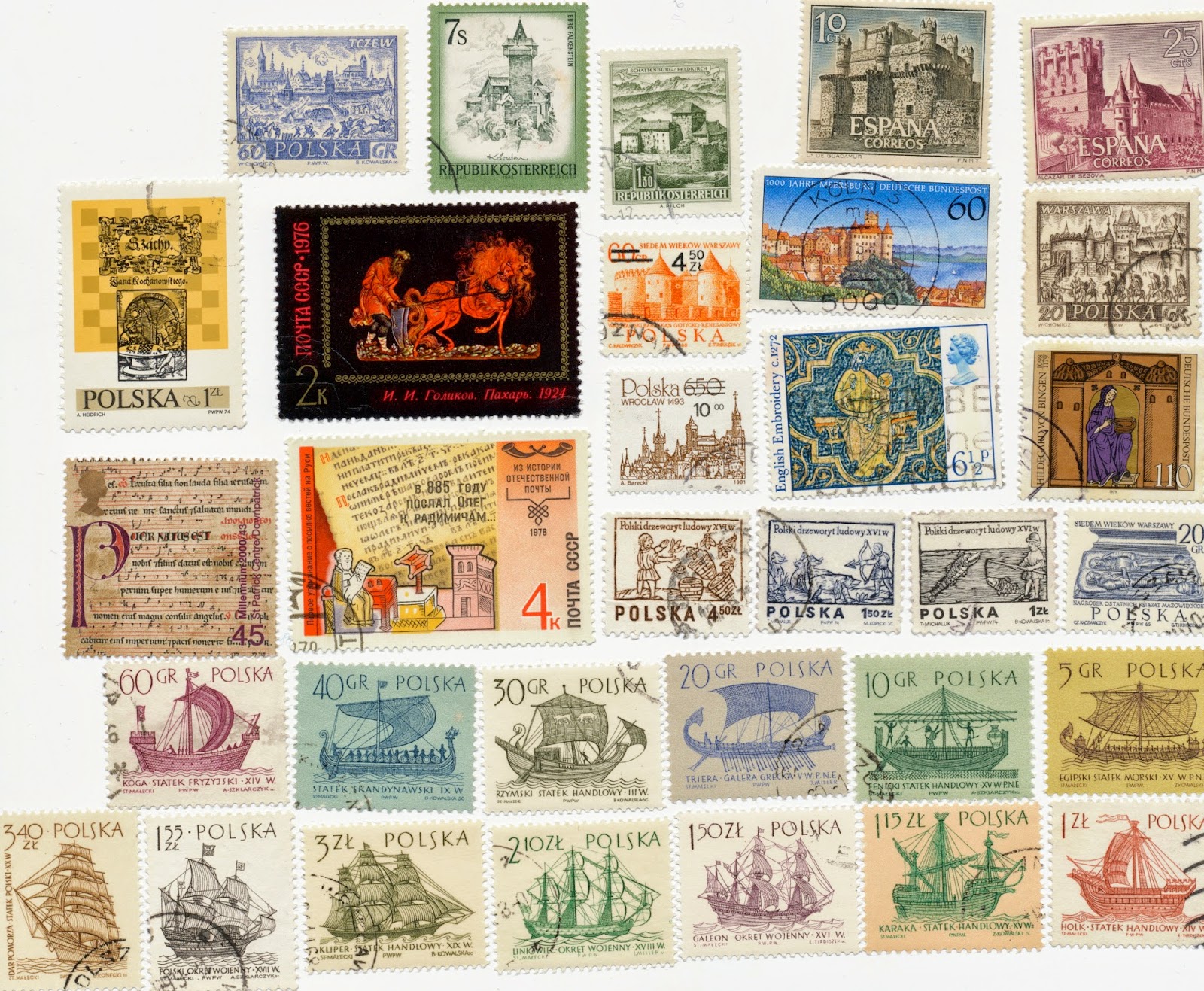
World-Building: Historical Stamps

Quite some time ago I scanned some of my stamps for blog posts and then forgot to do them all.  So here are some great stamps showing items of historical interest.


It's cool to see what's considered important enough by society to be made into stamps.  Above are some castles, a few medieval manuscript images (one of Hildegard of Bingen), some of scenes of life and historical boats.

I love series stamps, the ones that show progressions through history of something - like sailing ships.  They let you see how things change over time and how technology progresses.

History is full of complexities, and remembering the past - through mementos or specific references - is important to making the history in your fantasy novel feel real.  People have pasts, but so do places, technologies, 'old wives tales', mythologies, buildings, medicine, etc.  Everything comes from something, so a world that just plops down with no past doesn't feel grounded, doesn't feel real.  If you don't choose to map out thousands of years of history for your world, at least remember to add in a few tidbits of information about the past, and some mementos of that past lying around houses or pubs, or as scars on bodies.  Remind the reader that the ways things are done 'now' isn't how they were always done, or have changed and improved over time.

Friday, 14 March 2014

World-Building: Health Fads

One of the offsites I've done for the World's Biggest Bookstore over the years has been the HRPA (Human Resources Professionals Association conference).  A few years back one of the booths had an oxygen bar, which I wanted to try but didn't end up getting the chance to.  So when I saw a similar oxygen bar at this year's show, I made the time to go. 

This is a picture from the internet, but the booth at the show looked identical to this, minus the plasma globe and company id.

It was an interesting experience, sitting with a strap over my ears and the tube ends up my nose, getting a dose of concentrated oxygen.  I thought the slightly scented oxygen hit would wake me up, helping me get through the rest of the day.  In actuality it made me kind of tired.

So why mention it here?  First, it felt like a very sci-fi thing to do, sitting on a stool and getting a 'hit' of pure oxygen.  Second, it struck me that health fads are a huge part of modern day life and yet I don't remember reading a book - science fiction or fantasy - where a current fad is sweeping through.  (I will note here that not remembering one isn't the same as there not being one, I've never considered this before so it I've encountered a health fad in a book I've probably skimmed over it.)  And fads are universal.  Sure, the object of the fad will be different in different places, but fads can found everywhere, in every time, whether for food items, healing baths, clothing, cleanliness (a scented pomander ball anyone?), what have you.

That's not to say fads should be front and center of books, but mentioning one - and how the characters react to them (followers, sceptics) - could help make your world feel more real.