Showing posts with label Japan. Show all posts

Tuesday, 8 November 2016

Book Review: Toru: Wayfarer Returns by Stephanie Sorensen

Pros: interesting characters, good ending

Cons: advances are made ridiculously fast, some continuity errors, gets boring at times

After spending two years in America, Toru returns to Japan, defying the Shogun’s law of isolation and the death penalty his return will earn him. He knows American ships will come, forcing the country to open its borders on their terms, unless Japan can innovate and show its strength in time.

Toru is a great protagonist, deeply in love with his homeland but also an admirer of the technology and people he met in America. He straddles a difficult line as a commoner advising a Lord, trying to foster quick changes in a society that honours tradition.

I really liked Masuyo, Lord Aya’s feisty daughter. Her flaunting of custom on her father’s land was well contrasted by her embarrassment in front of other noble women, where she tried to fit society’s ideals. This accurately portrays the juxtapositions common in Japan today.

There were a lot of supporting characters, ranging from peasantry to Lords, many of whom had well defined personalities. While she’s negatively portrayed, I thought Lady Tomatsu was well done, snobbish and overly proud of her family name while married to a less powerful Lord. I liked that she had impeccable taste in food and clothing. I also thought she showed astute political sense, given her circumstances, though she makes a decision towards the end of the book that could have used more clarification as it seemed to go against her earlier personality.

The plot consists of Toru convincing people to build trains, telegraph machines, Babbage Difference Engines, airships, and more in order to face the American threat. While I can believe that some of what they accomplish is possible within a year, the sheer scope of their operations and how much they achieve - necessarily kept hidden from the Shogun and requiring parts to be ordered from overseas - is hard to believe. Masuyo, an admittedly intelligent and well-educated woman, somehow translates enough English (which she’s never seen before) and engineering data (for things she’s never heard of before) in less than a week to put together a list in one night of all thing parts the Japanese can manufacture themselves and others they’ll need to order so that they can start building trains, etc. right away. Despite the failure of engineers with more experience in France to build working airships, the Japanese manage to make one using dictionaries to translate the French and then improving on the designs, again, despite never having seen such schematics before or (I would guess) knowing the science behind them.

I also wondered how the smaller Lords Toru influences have enough money to finance the large - and expensive - projects. Added to this is how they believed they could keep what they were doing hidden from the Shogun. Given the sheer number of people involved and the obvious damage to the land, it seems unreasonable to believe the Shogun wasn’t aware of things from a very early point. 

For anyone looking for steampunk elements, there are airships towards the end of the book, and mention of submersibles, but not much else.

The inclusion of Japanese words and phrases for things helped keep the oriental flavour of the setting. In a few places the immediate translation felt awkward (as someone who knows a fair bit of Japanese), like ofuro bath (which basically mean the same thing). A handful of times the Japanese was left untranslated, which might trip up readers unfamiliar with the language. I personally had trouble figuring out the meaning behind the name of the first dirigible, which was commented on, but not translated (as far as I could determine).

There were some long sentences with awkward phrasing that I had to reread a few times in order to understand properly. I also noticed some continuity errors with regards to timing. One section began by saying it was the next morning and a character was preparing for a meeting, despite the fact that the meeting was to be in 3 days. Other times characters suddenly travelled weeks worth of distance in a few days (two characters were said to be at their homes but managed to be at least a 4 week journey away from their homes the next day). 

While I founds parts of the story a bit tedious, it’s basically set-up for future books where the divergence from history becomes more stark. There’s an author note at the end of the book explaining how this book compares to history (while the tech advance is all added, the meeting with Commodore Perry at the end and the difficulties between the Shogun and his Lords was cribbed from history). Following books are meant to diverge more, showing Japan in a position of power as its borders open.

While it’s not a perfect book, it was an interesting look at an interesting time (imagined as parts of it were) of Japanese history. The author’s familiarity with the language and customs (and gestures) shows through.


***SPOILERS***


Lady Tomatsu’s decision to leave Edo during Masuyo’s rescue confused me. She’d repudiated her husband in an effort to retain her lands for their son. The author didn’t make it clear that this only worked so long as her husband returned for his execution. Since he decided not to return, she and their son would be execution in his stead. This confused me until I figured out that the situation had changed between when Lady Tomatsu urged Masuyo to repudiate her father, thinking their menfolk dead, and the time of Lady Tomatsu’s rescue.


The travellers alluded to in my time error above are Lords Aya and Tomatsu, who are supposed to be prepping their lands for their upcoming execution, but turn up at Lord Date’s home the day after Toru and co escape from Edo. Another time error involved the date of the execution. It’s 3 weeks away, but somehow Commodore Perry spends a month or more in the South of Japan before the date arrives.

Sunday, 7 December 2014

Shout-Out: Yamada Monogatari by Richard Parks

In an ancient Japan where the incursions of gods, ghosts, and demons into the living world is an everyday event, an impoverished nobleman named Yamada no Goji makes his living as a demon hunter for hire. With the occasional assistance of the reprobate exorcist Kenji, whatever the difficulty - ogres, demons, fox-spirits - for a price Yamada will do what needs to be done, even and especially if the solution to the problem isn't as simple as the edge of a sword. Yet, no matter how many monsters he has to face, or how powerful and terrible they may be, the demons Yamada fears the most are his own!


Yamada no Goji is a minor nobleman of ancient Japan who has lost everything - except a single purpose: keep a promise to the woman he loved. In order to fulfill his vow, all he has to do is fight a horde of demons and monsters, bargain with a few ghosts, outwit the sinister schemers of the emperor's court, find a way to defeat an assassin who cannot be seen, heard, or touched - and change the course of history. Fortunately, Yamada specializes in achieving the seemingly impossible, so he is sure in some way to succeed...if he doesn't drink himself into oblivion first.

Friday, 11 March 2011

Japanese Earthquake

My thoughts are with the people in Japan after this disaster.  As someone commented on one of the news articles I've read, it's like watching a Hollywood disaster movie, only with real consequences in terms of loss of life and infrastructure.  The video clip shows tsunamis hitting Miyagi Prefecture, in the Sendai area.   I've been to Sendai several times, most recently last June, and it's heart-wrenching seeing this.

Friday, 2 July 2010

Japan Trip - Akihabara

We spent our last two days in Japan shopping. Of course, one of those days was set aside for Akihabara, the place to shop for anime memorabilia, figures, electronics and duty free. Everything we wanted was around the train station, but picking the correct exit proved to be a challenge. So we walked around the outside until we found a store we wanted.

But first, we had lunch at Ginzo for what turned out to be a fabulous meal for a very reasonable price. My husband had a large plate of sushi and a savory custard, I got tempura don, udon and custard - both meals came to $20 TOTAL and were among the best we had (in terms of quality as well as value) in Japan.

We were expecting new and used electronics stores (like this store selling used Macs for an excellent price), but we were both surprised by the number of electronics shops selling base components. And security cameras (love the screw and button cameras).

In the end, our trip to Japan was a lot of fun and a complete success in terms of seeing everything we'd planned. I already can't wait to go back!

Wednesday, 30 June 2010

Japan Trip - Taenoyu Onsen


No trip to Japan is complete without an excursion to an onsen. These natural hot springs are great for relaxing and loosening tired muscles. And they give a lot of insight into the Japanese mind.

I chose Taenoyu Onsen, part of the Nyuto complex because it allows internet reservations and it has a private bath. You arrange for your hour long private bath time when you arrive, along with your meal times.

The onsen also provides a complementary bath package including a small towel, toothbrush, brush, razor, shower cap and q-tips. The shower units in the onsen have shampoo, conditioner and body wash and with the large towels provided in the rooms and yukata for wear around the building guests don't have to bring anything!

There are 7 baths, 4 with 'gold' water, 3 with 'silver'. There are two male baths, two female (one indoor, one outdoor in each category and they change gender at 8 pm so you can try them all), 2 outdoor mixed baths and the private bath. (Pictured below are the two womens baths, the two outdoor baths, with their view of the waterfall, and the private bath.) We ended up trying all 7.

Meals were exquisite. Dinner consisted of more courses than I could count. Here was the table as the meal started. The tall pot was for kiritampo nabe, the smaller one for grilling bamboo stalks. To this were added a mushroom soup, white fish (complete with head, skin, etc.), rice and more.

Our beds were made up when we got back to the room after dinner. We put them away before heading down for breakfast the next morning. I'm used to onsen breakfasts to be rice, whole fish and an raw egg. So I wasn't expecting the feast that awaited us. Like dinner, more was brought to the table as we finished other dishes. The grill has bacon in it, which we cooked an egg on as well. The rolled bamboo holders in the metal basket held natto (fermented soy beans) - not my favourite, though I did manage two bites without throwing up. :P

This was by far the best onsen I've ever visited. The quality of the food and service were top notch. It was also the most expensive onsen I've been to, but I'd say it was worth every yen.

Japan Trip - Lake Tazawa

Half an hour by train from Morioka is Lake Tazawa, the deepest lake in Japan. It's ringed by mountains, making it great for photography.

We walked along a small segment of the lake, looking at fuji flowers (wisteria) and birds before having the local specialty, kiritampo nabe (grilled pounded rice in a vegetable hotpot), for lunch. We also tried misotampo (pounded rice, grilled over an open flame and smeared with miso paste).

Saturday, 26 June 2010

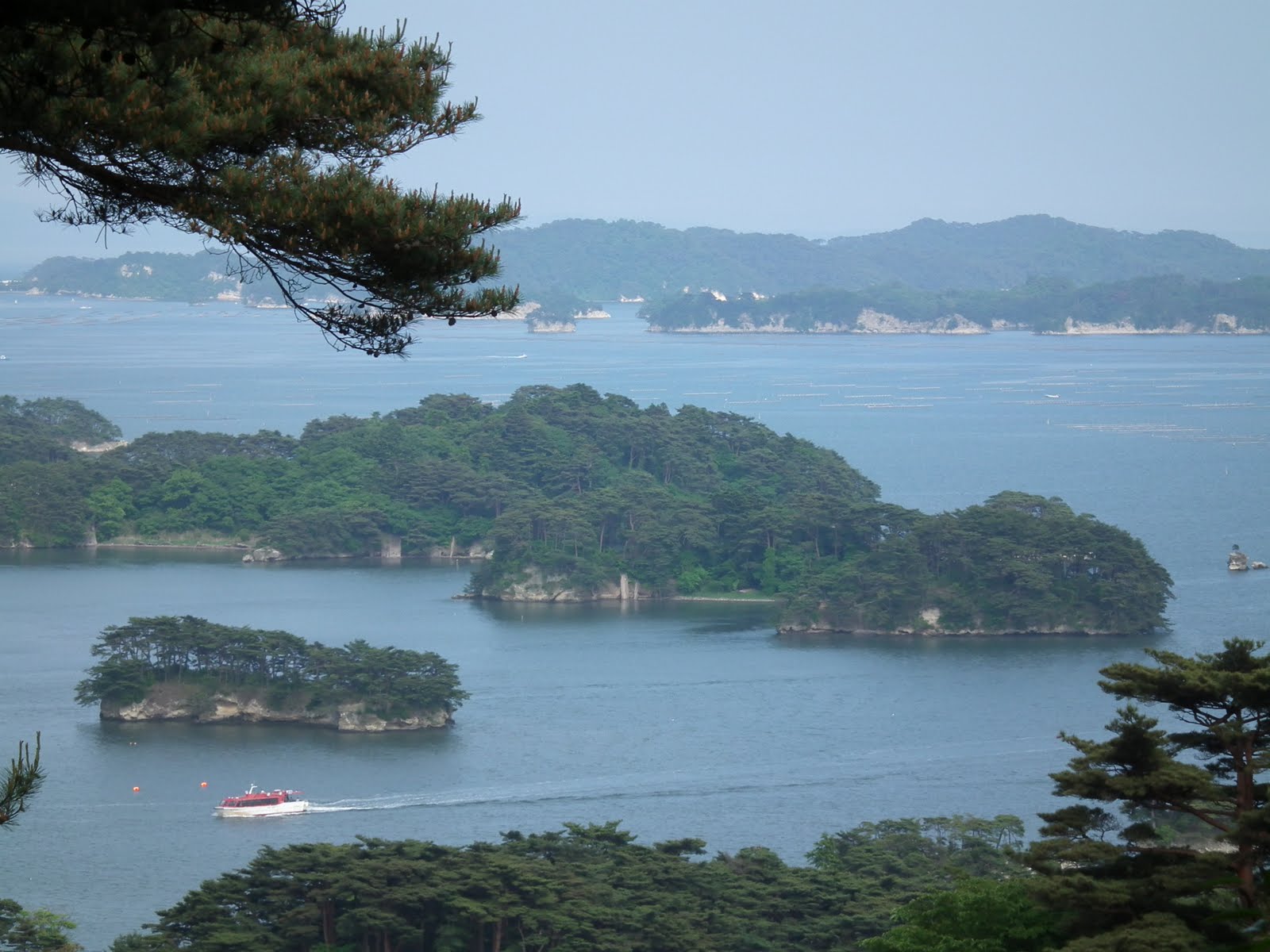
Japan Trip - Matsushima

As it's the one thing not associated with the bay, we decided to walk through the paths to Zuiganji Temple first. There are two paths, one lined with cedar trees,

the other with trees on one side and caves that used to be used by the monks for meditation on the other. As you can see, this area had lots of green moss.

We skipped the Temple and headed to Godaido, an island with a shrine on it. It's the island closest to the mainland, and didn't have much of a view owing to all the trees around it.

The second accessible island, Fukuurajima, had a great view. It's got the longest bridge, and is a symbol for the area.

It's a very popular place for tour boats. My first trip here, many years ago, I entered the bay via tour boat (and subsequently didn't get a map of the area or know where the train station was). I don't remember my boat being followed by a swarm of birds either.

After Fukuurajima, we walked back through Matsushima, stopping for lunch before going to Oshima island. It's the last of the islands you can reach via red bridges. Like the path to Zuiganji, it has caves where monks used to meditate, and different views of the bay.

Matsushima is the epitome of Zen Buddhism, you can't see all of the islands from one vantage point, and if you move, your view of the islands change - so what was visible before is now obstructed. I can see why so many monks chose this area for their worship, beyond the fact that it's a beautiful area.

The woman at the tourist information office, who gave us our map of the area, mentioned a look out point at a park above the bay. We decided to try for it - and got lost. The map's not that accurate, and while we found two look out points I don't think we actually found the park... Still, the view from there was exquisite, so it was worth the walk. It's not hard to understand why Matsushima is one of the Three Views of Japan.

Friday, 25 June 2010

Japan Trip - Himeji Castle


Wednesday June 9th, we decided to try Himeji and see how the castle looked, restoration and all. Discovering that the castle would be off limits during our trip was a major disappointment and I debated finding another castle to go to instead (and found one. But Himeji, the White Heron Castle, makes anything else settling for less).

One of my readers, Anrake, send me this link in a comment, which helped influence the decision to try Himeji after all. I'd tried to find up to date photos of the castle to see how far along the renovations had gotten and didn't have much luck.

We started with an outside tour of the castle grounds, including the moat. This meant we stumbled across the Hyogo Prefectural Museum of History. Not only is the mirrored view of Himeji Castle near the entrance beautiful, the museum has some great - and free - exhibits. Finishing our tour, we saw a heron in the outer moat!

So, to anyone thinking of heading to Himeji in the near future, it's still an amazing site. Yes, construction is going on and one building is covered in scaffolding and several cranes are around the main keep, and yes, some views are impossible to get clear shots of, but with some creative photography you can still get great pictures.

In addition to the heron we saw in the outer moat, we saw one fishing the inner moat.


I was led to believe that the castle grounds were closed. They weren't. We were able to walk right up to the keep, entering the West Bailey and Long Corridor and seeing the Koshi-kruwa storehouse and all other features.

Yes, it's a shame you can't enter the main keep, but the rest of the castle makes up for that. And since the keep isn't covered with scaffolding yet, I highly recommend going.

Thursday, 24 June 2010

Japan Trip - Fushimi Inari Shrine

We headed the next day for, what I thought, would only be an hour or two excursion: the Fushimi Inari Shrine. It turned into a full day of walking up and down steep steps surrounded by red torii gates.

First off, if you ever go there, get a map! I picked one up back where we started, several hours after it would have been useful, at one of the tourist shops for free. The map notes the shrine names in Japanese and shops along the way in English and Japanese. It also shows where the trails diverge and leave the shrine complex (which would have prevented us from taking an hour + detour).

We started on Omote Sando street and walked to the Fushimi Inari Taisha Shrine.

Then we headed along one side trail to the Senbon Torii (thousand torii).

Walking between hundreds of tightly packed torii is pretty awesome. There's enough room for the sun to peek through every foot, but it's still a bit surreal. This segment is what I thought the shrine was, so I was very surprised to reached another large shrine and discover the torii continue. And boy do they continue.

We ended up climbing past numerous side shrines, a viewing platform (where the trail splits and it's VERY easy to take the wrong path - as we did and another couple was about to) and the hilltop Shin Pond.

The front of the torii all have the same two symbols on the cross bars. The backs however, have the name of the donor and date on each. And if you're wondering how much it costs to have a wooden memorial, here's the pricing chart. (The rule of thumb I followed for yen when I lived in Japan is to remove the last two 0's and consider that the US price. It's not as accurate now, but will give you a general idea of how expensive these are.)

Wednesday, 23 June 2010

Japan Trip - Kiyomizu Dera

The second major temple I felt Brad couldn't leave Japan without seeing, was Kiyomizudera. In addition to being a beautiful temple, it's in a gorgeous area as well. From the front you can see the mountains ringing the city, from the back you have a tree filled vista.

The temple was crawling with junior high school students, two groups of which stopped us to answer questions for their school project :) . (In total we we stopped by 4 groups the first two days, none after that.)

Looking down from the two viewing platforms, you can see the Kiyomizu (clear water) fountain the temple is named for. You can even stand in line and taste the fresh spring water.

Just outside the temple is a huge hilltop cemetery. We spent some time wandering around it before heading on.

After walking down the ninenzaka and sannenzaka (2nd and 3rd steps) we saw a maiko (apprentice geisha) on her way to a job. A bit further along the road we came to Marounuchi Park, where we stopped to read for a while.. The park was riddled with crows and beautiful views. Like the one below.